“Observation of Gravitational Waves from a Binary Black Hole Merger”: it was under this title that, ten years ago, the LIGO and Virgo experimental collaborations published in the journal Physical Review Letters the article that presented to the international scientific community and to the world the discovery of gravitational waves. The scientists of the two collaborations thus wrote and signed a new, extraordinary chapter in the book of science. A historic milestone, recognized with the Nobel Prize in Physics the following year, which crowned the dream and the endeavor of thousands of people and hundreds of institutions around the world who had worked on it. A dream and an endeavor that even Albert Einstein had considered impossible to realize, despite having predicted the existence of gravitational waves a hundred years earlier in his theory of general relativity: ripples in spacetime, the four-dimensional structure of the universe, that propagate through the cosmos at the speed of light after being produced by astrophysical cataclysms, and whose effects on Earth, in Einstein’s time and long thereafter, were thought to be far too infinitesimal to be measured. And yet, after fifty years of research and technological developments beyond the state of the art, the dream was realized and the endeavor successfully completed, through initiative and perseverance.
Italy and France played a leading role in this achievement, with the National Institute for Nuclear Physics (INFN) and the Centre National de la Recherche Scientifique (CNRS) and their scientific communities, which in Europe founded, funded, and jointly carried out the Virgo project within the European Gravitational Observatory (EGO) consortium, today the only European center where direct research on gravitational waves is conducted and where new generations of scientists can be trained in the field.
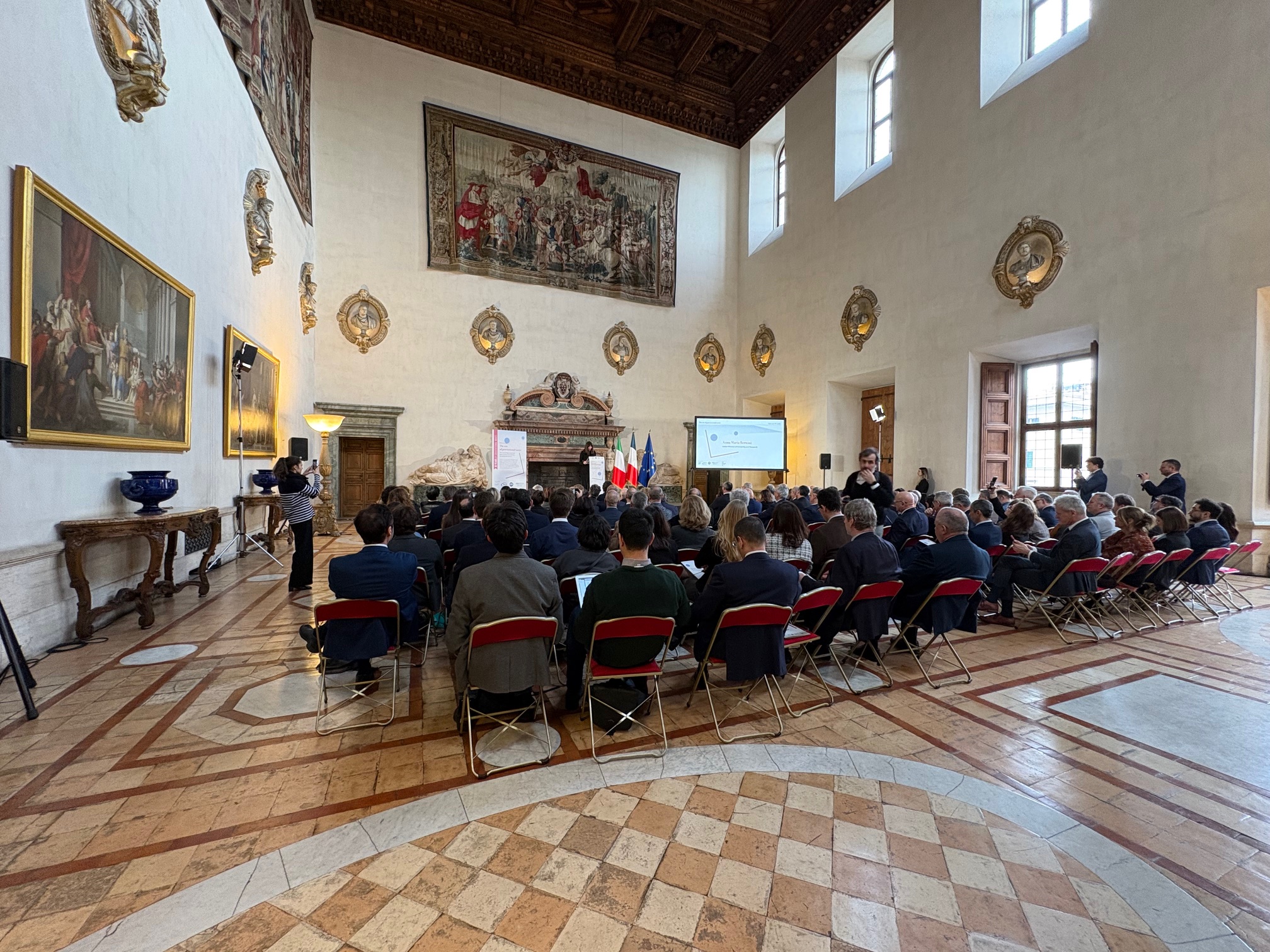
Today, 12 February 2026, the Ministry of Universities and Research (MUR), the INFN, the CNRS, and EGO promoted the event, hosted by the French Embassy in Rome, The Era of Gravitational Waves. Ten Years of Virgo Science and Future Prospects for a New Way of Exploring the Universe, to celebrate the tenth anniversary of the first historic observation of gravitational waves, retrace the discoveries that have arisen from this new way of studying the universe, and look to the future of research in the field with the upgrading of current detection instruments and the design of new ones, such as the future third-generation interferometer, the Einstein Telescope.
«Scientific progress arises from cooperation and from the ability to share vision, expertise, and investments», comments the Minister of Universities and Research, Anna Maria Bernini. «This is the deepest meaning of European integration in research: networking national excellences to generate results that no single country could achieve on its own. Virgo and EGO represent one of the highest examples of this model. Italy and France, working together for over twenty years, have made a decisive contribution to the development of gravitational astronomy, opening a new era in observing the universe. Today that experience propels us toward the Einstein Telescope: the next great European scientific challenge and the new frontier for observing gravitational waves. Italy has chosen to play a leading role in this path, with a clear political and financial commitment, convinced that scientific cooperation can truly make a difference in frontier research and thus in global progress», concludes Minister Bernini.
«The story of gravitational waves is, indeed, a long, difficult, and beautiful endeavor. It began over a hundred years ago with a theoretical hypothesis by Einstein that was initially considered unverifiable, and it began to take shape fifty years later, when technological progress made it possible to conceive and build instruments capable of observing ripples in spacetime. And Italy and France, thanks to Adalberto Giazotto and Alain Brillet, who launched the Virgo project, were at the forefront of this endeavor from the very beginning, collaborating with vision, courage, and determination», comments Antonio Zoccoli, President of INFN. «In Italy, the path had been opened by Edoardo Amaldi, who initiated research into gravitational waves and founded a school of excellence. Thanks to his legacy and to the contributions over the years of our entire community, today our country has the scientific, technological, and industrial expertise to face the next great challenge: the Einstein Telescope, the third-generation interferometer that we hope to host in Sardinia, with the support of the Government and the Ministry of Universities and Research, and in particular of Minister Anna Maria Bernini», concludes Zoccoli.
«This discovery is the result of decades of shared vision between France and Italy, through the CNRS and the INFN, together with our European colleagues. But today, ten years after the observation of the first gravitational event, the most important message is not about what we have already achieved, but about what lies ahead», comments Alain Schuhl, Deputy CEO for Science at the CNRS.
«Celebrating, ten years on, the announcement of the discovery of gravitational waves means at the same time recalling the history that led us to that extraordinary success and looking to the future», comments Massimo Carpinelli, Director of EGO. «Thanks to the visionary proposal of Adalberto Giazotto and Alain Brillet and to the farsighted Italian-French alliance, more than thirty years ago the INFN and the CNRS launched in Italy the project for one of the world’s only three large gravitational antennas, Virgo, and founded the European Gravitational Observatory in Cascina. It is the success of this epoch-making scientific endeavor that today enables Europe, and Italy, to aspire to leadership in one of the most promising fields of fundamental research, by realizing the Einstein Telescope, the next-generation gravitational detector», concludes Carpinelli.