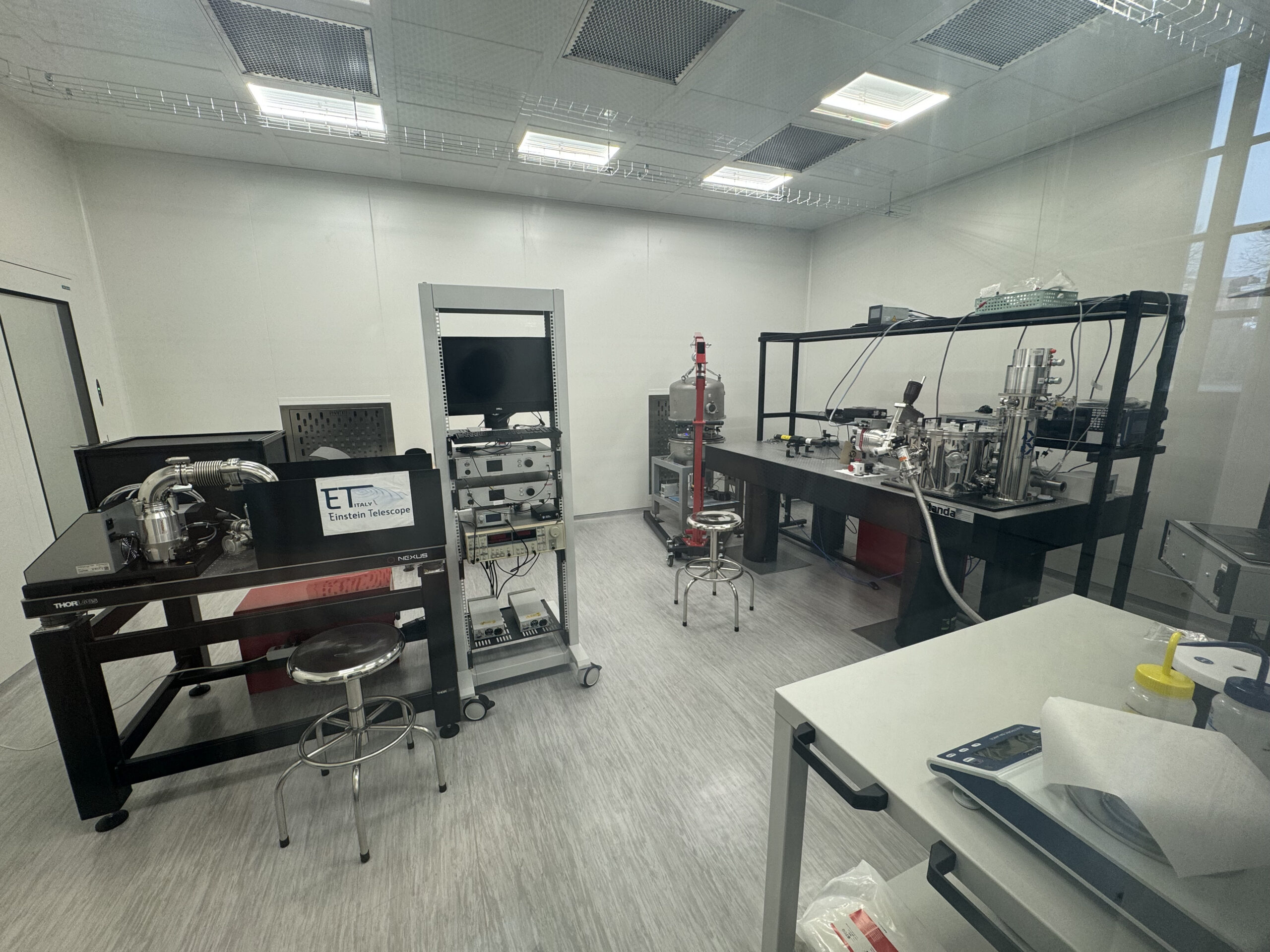
It was inaugurated today, 19 February 2026, in the laboratory spaces of the INFN Section at the Department of Physics of the University of Rome Tor Vergata, the new AiLoV-ET laboratory (Advanced Optics Lab @ Tor Vergata for Einstein Telescope). The infrastructure is dedicated to research and development of technologies for the future next-generation gravitational wave detector, the Einstein Telescope, and is the result of a collaboration between INFN and the University of Rome Tor Vergata within the ETIC project, funded by the Ministry of University and Research through NRRP funds. The project aims to promote the Italian candidacy of Sardinia to host the Einstein Telescope through the creation of a national network of laboratories distributed across the country, of which the AiLoV-ET infrastructure is also a part.
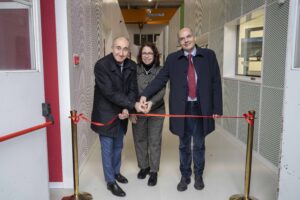
Traditional ribbon-cutting ceremony. Credits: University of Rome Tor Vergata.
«Thanks to funding of around three million euros, the new AiLoV-ET laboratory hosts clean and grey rooms, namely controlled-contamination environments typical of an instrumental physics research laboratory, optical benches, lasers, mirrors, and highly advanced technological instrumentation», explained Viviana Fafone, head of AiLoV-ET, professor at the University of Rome Tor Vergata and researcher at INFN. «AiLoV-ET is therefore, in every respect, an internationally significant research center, focused on the development of technological solutions in adaptive optics and new materials for the detector mirrors, which are key elements for the scientific goals of the Einstein Telescope. This activity is part of a research tradition on gravitational waves that has been active at Rome Tor Vergata for over forty years, from the first cryogenic bar detectors, to the Virgo interferometer, and up to the current developments for the Einstein Telescope», Fafone concluded.
«With great pride we inaugurate AiLoV-ET, a new and important chapter in the scientific history of our university», commented Nathan Levialdi Ghiron, Rector of the University of Rome Tor Vergata. «This infrastructure stems from the synergy with INFN within the ETIC project supported by the MUR with NRRP funds: a concrete example of how collaboration between institutions, supported by a national and European strategic vision, can generate frontier research and technological innovation. It is an investment not only in infrastructure but also in people – the Rector emphasized – in our researchers, young scholars, and students, who here find an environment for advanced training and international collaboration. AiLoV-ET is not just a laboratory; it is a sign of confidence in science, in European collaboration, and in our country’s ability to play a leading role in the great challenges of knowledge», the Rector concluded.
«Einstein Telescope represents one of the most ambitious scientific challenges of the coming decades and requires the development of highly innovative technologies. The new AiLoV-ET laboratory will operate in the field of thermal control of mirrors, an area already crucial in current interferometers such as Virgo, but destined to become even more strategic in next-generation observatories like the Einstein Telescope», explained Marco Pallavicini, member of the INFN Executive Board with responsibility for the Einstein Telescope project. «The creation of the laboratory arises from the fruitful collaboration between INFN and the University of Rome Tor Vergata, in continuity with the synergy already well established within the Virgo experiment».
The inauguration was followed by a conference on forty years of research at Rome Tor Vergata and on gravitational-wave research, with sessions dedicated to history, the current state of the art, and future prospects. Contributions were given by Michele Mazzola of the Ministry of University and Research; Lucio Cerrito, Director of the Department of Physics at the University of Rome Tor Vergata; Roberta Sparvoli, Director of the INFN Rome Tor Vergata Section; Renato Baciocchi, Vice-Rector for Technology Transfer at the University of Rome Tor Vergata; Eugenio Coccia, Director of the Institute of High Energy Physics in Barcelona; Viviana Fafone, head of the AiLoV-ET laboratory; Michele Maggiore, member of the Einstein Telescope Executive Board and professor at the University of Geneva; Marco Pallavicini of the INFN Executive Board; and Michele Punturo, coordinator of the Einstein Telescope scientific collaboration and INFN researcher.