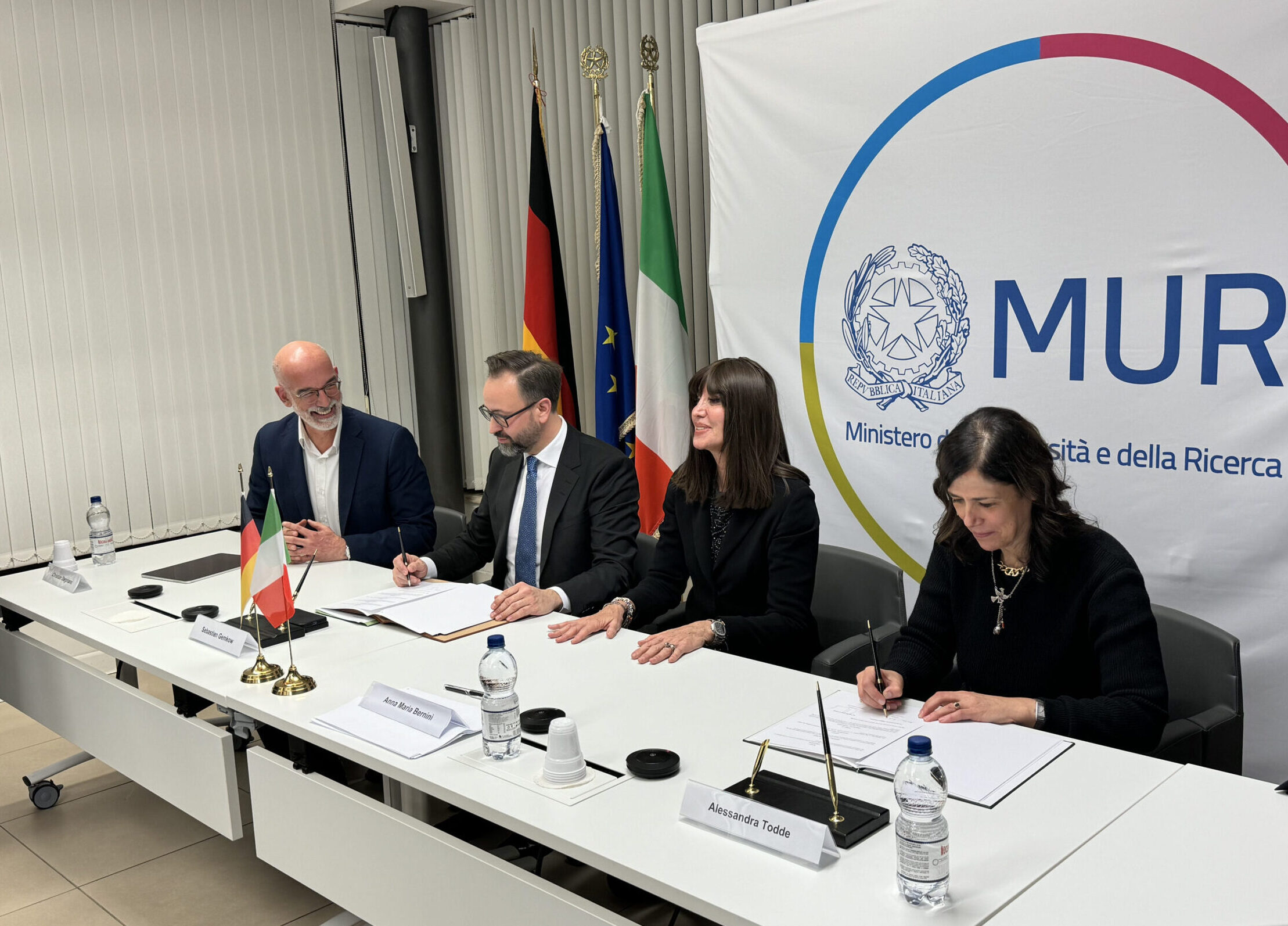
On Monday, 12 January, in Rome at the headquarters of the Ministry of Universities and Research (MUR), the President of the Sardinia Region, Alessandra Todde, and the Minister of Science of the Free State of Saxony, Sebastian Gemkow, signed a declaration of intent aimed at strengthening scientific cooperation. The main objective of the agreement is to support the Einstein Telescope (ET) project, a future observatory for gravitational wave research, which both regions are candidates to host. The signing took place in the presence of Minister Anna Maria Bernini and representatives of the National Institute for Nuclear Physics (INFN) and the Deutsche Zentrum für Astrophysik (DZA). Earlier in the morning, the scientific delegations had met at the INFN headquarters for a preliminary technical meeting.

Preliminary technical meeting between the scientific delegations of Sardinia and Saxony (INFN presidency).
Sardinia is proposing to host the infrastructure in the Sos Enattos area, in the Nuoro area, while Saxony is proposing a site in the Lusatia region. A third candidate site is located in the Meuse-Rhine Euregio, on the border between the Netherlands, Belgium, and Germany. The scientific community is currently evaluating two possible configurations for the experiment: a triangular solution, with three arms of about 10 kilometers to be built at a single site, or a configuration consisting of two L-shaped interferometers, each with two perpendicular arms of about 15 kilometers, to be built at two separate and geographically distant sites.
One of the central elements of the agreement between Sardinia and Saxony is precisely the support for the “double-L” solution, which is considered particularly effective in terms of scientific impact, technical feasibility, cost efficiency, and risk mitigation. This option has also been endorsed by Nobel laureate in physics Giorgio Parisi, president of the technical-scientific committee established by MUR to support the Italian candidacy to host ET, in a recent article published in Der Tagesspiegel.
More specifically, the declaration provides for the launch of a structured scientific cooperation between the two regions, with the direct involvement of universities and research institutions engaged in the ET project (including the Universities of Cagliari and Sassari, INFN, INAF, INGV, the Technical University of Dresden, and the DZA). This cooperation will take shape through the development of joint research and technological projects, the sharing of geophysical, seismic, and environmental data related to the two candidate sites, and the launch of joint training and postgraduate programs in astrophysics and gravitational-wave physics.
«The agreement between Sardinia and Saxony strengthens a shared vision and ambition: to develop a solid, long-term collaboration in the field of gravitational waves, one of the most advanced areas of global scientific research, also thanks to the support of the Ministry of Foreign Affairs and International Cooperation and to the spirit of institutional cooperation shown by the President of the Sardinia Region, Alessandra Todde, who made a decisive contribution to strengthening dialogue and joint work», emphasized the Minister of Universities and Research, Anna Maria Bernini.
«Einstein Telescope is a major research infrastructure and represents a strategic investment in the future of fundamental science, advanced technologies, and Europe’s ability to remain competitive and attractive in a rapidly changing global context. Cooperation between Sardinia and Saxony shows how territories that differ in history, geography, and traditions can work together to build a shared scientific future, founded on excellence, openness, and mutual trust», the Minister concluded.
«Today is a crucial day in the ambitious path we have undertaken with the candidacy of the Sos Enattos site to host ET», commented the President of the Region, Alessandra Todde. «From the very beginning», she explained, «we did not see Saxony’s candidacy as an additional obstacle on our path. On the contrary, we seized the opportunity to join forces to reach a goal together – one that is also desired by the scientific community. The same Nobel Prize winner in physics, Giorgio Parisi (president of the technical-scientific committee established by MUR to support the Italian candidacy), has advocated this solution».
«Collaboration with another peripheral European region such as Saxony», Todde continued, «represents added value for us. We have reached this milestone through work built over time, together with the Ministry of Universities and Research, the scientific community, the Ministry of Foreign Affairs, and Ambassador Ettore Sequi. A patient effort based on relationships, data, and continuous dialogue, for which I thank everyone, starting with Minister Anna Maria Bernini, who has always supported the project within a framework of loyal and fruitful institutional cooperation».
«Scientific collaboration between the Italian and Saxon communities, particularly in the context of the Einstein Telescope project, is solid and has been underway for some time, as demonstrated by the letter of intent signed at the end of 2024 between INFN and DZA and by the joint scientific activities currently ongoing at the candidate sites», stressed the President of INFN, Antonio Zoccoli. «The fact that this collaboration is now also extending to political institutions represents a further fundamental step, strengthening the bids of both regions to host the future gravitational-wave observatory».
The signing of the agreement seals a path of collaboration that had already begun some time ago, both politically and scientifically. In December 2024, INFN and DZA had already signed a letter of intent to enhance cooperation on research and technological development activities related to ET. In June 2025, a meeting was held in Dresden between the Saxon Minister of Science, Sebastian Gemkow, and an Italian delegation composed of representatives from MUR, the Ministry of Foreign Affairs, the Sardinia Region, and INFN, which initiated discussions on possible synergies between Italy and Saxony in the context of ET and laid the groundwork for the agreement just signed. Finally, last November a joint team of researchers from INFN, DZA, and the Karlsruhe Institute of Technology (KIT) installed an advanced electromagnetic noise monitoring station near Bautzen, in Saxony, at the site proposed to host ET, further strengthening collaboration between the two scientific communities.