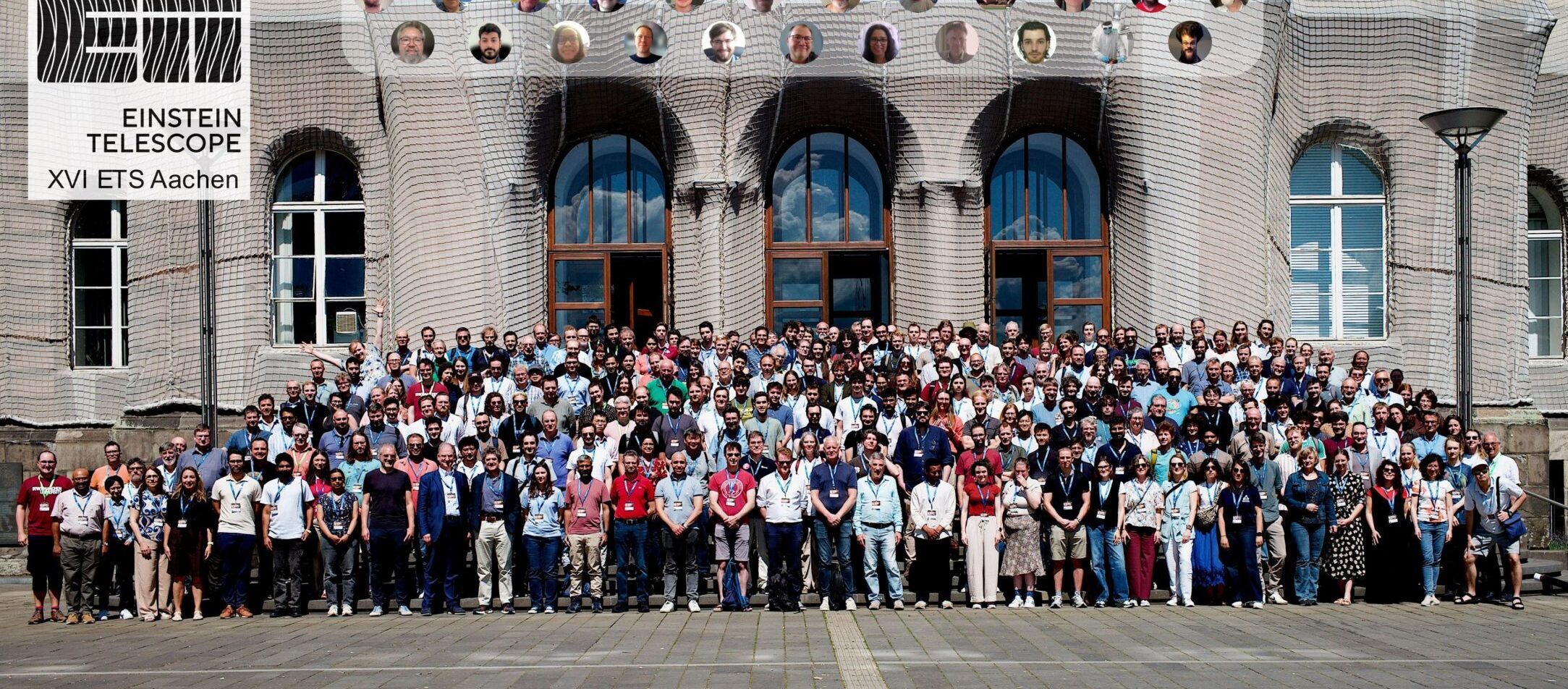
During the XVI Einstein Telescope Symposium, held from 15 to 19 June 2026 in Aachen, Germany, the new European project ET-COMPASS (COordination, Management, Planning And Strategic Support) was presented. The project, which was formally approved by the European Commission on 1 May 2026, is coordinated by the National Institute for Nuclear Physics (INFN) and is tasked with supporting the Einstein Telescope Organisation (ETO), as well as the broader Einstein Telescope initiative, on its path toward the implementation phase.
«Einstein Telescope is the largest future research infrastructure included in the roadmap of the European Strategy Forum on Research Infrastructures (ESFRI), and bringing it to completion is a complex undertaking: ET-COMPASS is the project that will help ensure its success», explains Alberto Masoni, INFN researcher and coordinator of ET-COMPASS. «INFN’s coordination of this European initiative further confirms the Institute’s commitment to this major project for gravitational-wave research».
ET-COMPASS will begin in January 2027, taking over from the ET-Preparatory Phase project, which will conclude next December. The project will have two years to achieve its objectives and will benefit from €1.5 million in funding, awarded through a call dedicated to projects included in the 2021 ESFRI Roadmap – the European Strategy Forum on Research Infrastructures document that identifies the major scientific infrastructure projects considered strategic investments at the European level.
The candidate projects were required to focus on the key organizational and management aspects needed to transition from the preparatory phase to the operational phase, such as governance design and human resources management. Within this framework, nine research institutions from nine countries – INFN (Italy), Nikhef (Netherlands), KU Leuven (Belgium), Montanuniversität Leoben (Austria), IFAE (Spain), Astrocent (Poland), the University of Glasgow (United Kingdom), the Deutsches Zentrum für Astrophysik (Germany), and the University of Rijeka (Croatia) – will work jointly and in collaboration with ETO on specific management-related aspects of the Einstein Telescope.
The activities planned under the project are complementary to the ongoing processes of defining the detector geometry and selecting the site. They include the further development of organizational structures, methodologies and procedures for the project’s economic assessment, strengthening ETO’s operational capacity, enhancing communication activities, expanding the number of partners, and increasing their engagement in the initiative.