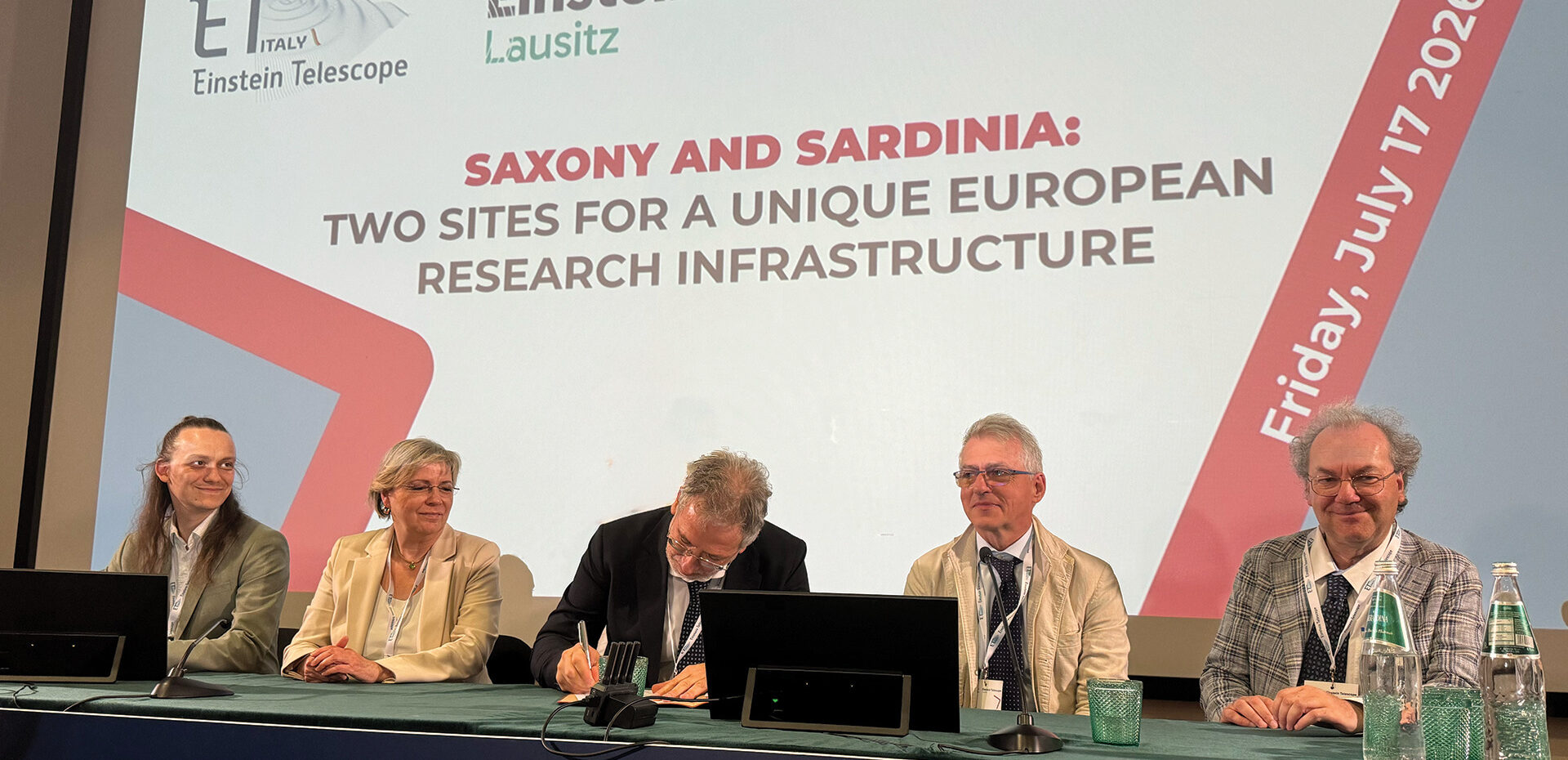
Today, Friday, 17 July, the Einstein Telescope (ET) project and the Sardinia candidacy to host it, with the proposed site in the Sos Enattos area, took center stage in Nuoro and Lula. Sardinia and Lusatia, a region of Saxony in Germany, took another joint step forward for ET, the future third-generation European gravitational-wave observatory. The leading Italian and German research institutions involved in this field signed a Memorandum of Agreement (MoA) in Nuoro to strengthen scientific cooperation between the two candidate sites and promote the construction of the infrastructure in the so-called “double L” (2L) configuration.
The signing ceremony, held at the conclusion of a scientific workshop hosted by the Sardinian Ethnography Museum, brought together representatives of the Italian National Institute for Nuclear Physics (INFN), the National Institute for Astrophysics (INAF), the National Institute for Geophysics and Volcanology (INGV), TU Dresden, and the Karlsruhe Institute of Technology (KIT). The agreement follows the Declaration of Intent signed in January 2026 at Italy’s Ministry of University and Research in Rome by the Autonomous Region of Sardinia and the Free State of Saxony, confirming the intention to submit a joint candidacy based on the 2L geometry, which envisages the construction of two interferometers, one in Sardinia and one in Lusatia. The proposal aims to capitalize on the geological characteristics and scientific expertise of both regions, maximizing ET’s scientific potential while strengthening European cooperation in frontier research.
The ceremony was attended by the presidents of INFN, INAF and INGV, Antonio Zoccoli, Roberto Ragazzoni, and Fabio Florindo, as well as Angela Rösen-Wolff, Vice-Rector for Research and Technology Transfer at TU Dresden; Christian Stegmann, Co-Scientific Director of the Einstein Telescope Lusatia feasibility study; Alessandra Todde, President of the Autonomous Region of Sardinia; Heike Graßmann, State Secretary at the Saxon Ministry of Science; the mayors of Nuoro and Lula, Emiliano Fenu and Mario Calia; and the mayor of the Saxon municipality of Ralbitz-Rosenthal, Hubertus Rietscher. During the morning session, a brief message from Anna Maria Bernini, the Italian Minister of University and Research, was also read.
On the sidelines of the ceremony, a cooperation agreement was also signed between the Region of Sardinia and the Region of Umbria, in the presence of their respective presidents, Alessandra Todde and Stefania Proietti.
In the afternoon, attention shifted to Lula, at the heart of the proposed Sos Enattos site, where the Einstein Telescope Information Point was officially inaugurated at the Giovanni Paolo II Hall, located at Via Karl Marx 1. The day concluded at the former Sos Enattos mine with the launch event for the future ET-SUnLab research center, whose construction is expected to begin in the coming weeks.
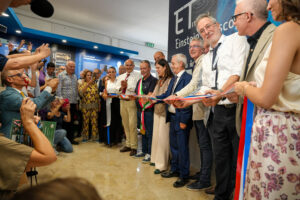
Ribbon-cutting of the Lula Einstein Telescope Information Center.
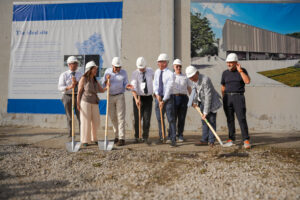
Groundbreaking ceremony of ET-SUnLab.
«Today’s events mark an important milestone in our journey to bring the Einstein Telescope to our island. We have strengthened our collaboration with Saxony thanks to the Italian and German scientific communities, which today reaffirmed the agreement signed in Rome last January to pursue a joint candidacy. We have also established a Sardinia-Umbria partnership that will be valuable not only for ET, but also for promoting, supporting and enhancing scientific research and technological innovation through the development of joint projects and initiatives,” said Alessandra Todde, President of the Autonomous Region of Sardinia. «Finally, we have given concrete form to the work carried out over the past two years with the inauguration of the ET Information Point in Lula and the launch of construction activities for ET-SUnLab at Sos Enattos. In addition to having the best site, every day we strengthen the infrastructure and technological ecosystem that increases our chances of success».
«The signing of this agreement represents a significant step forward because Sardinia and Saxony are reinforcing their shared commitment to present a joint candidacy and cooperate in offering Europe the most scientifically robust and programmatically reliable solution. Based on the studies conducted so far, we are convinced that implementing the Einstein Telescope through two L-shaped interferometric detectors provides the best conditions for the project’s success», said Antonio Zoccoli, President of INFN. «This vision goes beyond cooperation between the two candidate sites and paves the way for a truly European research infrastructure, involving all partners in the creation of a distributed network for gravitational-wave research, with laboratories, technological facilities and scientific activities across different countries. Each participant will be able to contribute its own excellence and benefit from the collaboration. A major research infrastructure can only emerge from major collaboration: this is how science works, and only in this way can Europe build a unique scientific instrument capable of generating new knowledge and strengthening European leadership in fundamental research for decades to come».
«Today we are witnessing Europe at its best. By signing this agreement, two of Europe’s most suitable and seismically quiet regions, Sardinia and Lusatia, are joining forces to pursue one of the most ambitious scientific goals of our time through the development of the most advanced technologies for detecting the tiniest ripples in spacetime», said Roberto Ragazzoni, president of INAF. «The same spirit of curiosity that led Galileo to turn his eyes to the sky continues to inspire discovery and drive technological, economic and societal progress. Our quest to observe the events that have shaped the Universe – from the merger of black holes to spectacular phenomena such as kilonovae – is not only about satisfying humanity’s curiosity. It is also about advancing technology, strengthening European scientific cooperation and creating opportunities whose impact cannot yet be foreseen. This is fundamental research at its best: history has shown that its greatest achievements often surpass our expectations and open entirely new horizons. Working together as a single observatory, the two L-shaped interferometers will reveal aspects of the Universe that have remained hidden until now. The time has come to look to the sky once again, with new eyes».
«The signing of this Memorandum marks an important step in the path we are building together with our Saxon partners. Major research infrastructures are born not only from scientific excellence, but also from the ability to share expertise, experience and common goals,” said Fabio Florindo, President of INGV. «INGV brings to this collaboration its extensive knowledge of the Earth and subsurface. For an infrastructure such as the Einstein Telescope, geological and geophysical site characterization is essential, and we have been working on it with scientific rigor and a long-term vision for many years. I believe the value of this agreement extends well beyond preparing our respective candidacies. It is a tangible example of how cooperation among research institutions can strengthen Europe’s role in addressing major scientific challenges while creating new opportunities for development and innovation in the regions involved».
«This marks another milestone in our partnership as candidate regions for the European flagship project, the Einstein Telescope. Sardinia and Saxony share a common vision for this unique research infrastructure», said Sebastian Gemkow, Saxon State Minister for Science, Culture and Tourism. «The agreement signed by leading Italian and German research institutions reinforces our joint bid to host a distributed underground gravitational wave observatory while deepening scientific cooperation across national borders».
«Our cooperation on the Einstein Telescope will become even closer in the years ahead. It extends well beyond the research infrastructure at our two sites, bringing together science, innovation, and people across Europe», added Christian Stegmann, Co-Director of Einstein Telescope Lausitz.
«The cooperation agreement is an important milestone on Lusatia’s way to hosting the Einstein Telescope. It underlines the European dimension of this unique research project and stands for our ambition to shape scientific excellence beyond borders, concluded Ursula Staudinger, rector of the University of Technology Dresden. As university of excellence, TU Dresden offers its strengths in fields like high-performance computing, AI-supported data analysis, optoelectronics and precision measurement. At the same time, the ET offers the great opportunity to further develop key technologies. We wholeheartedly support this joint European candidacy».
Photo credits: Cristiana Solinas / INFN