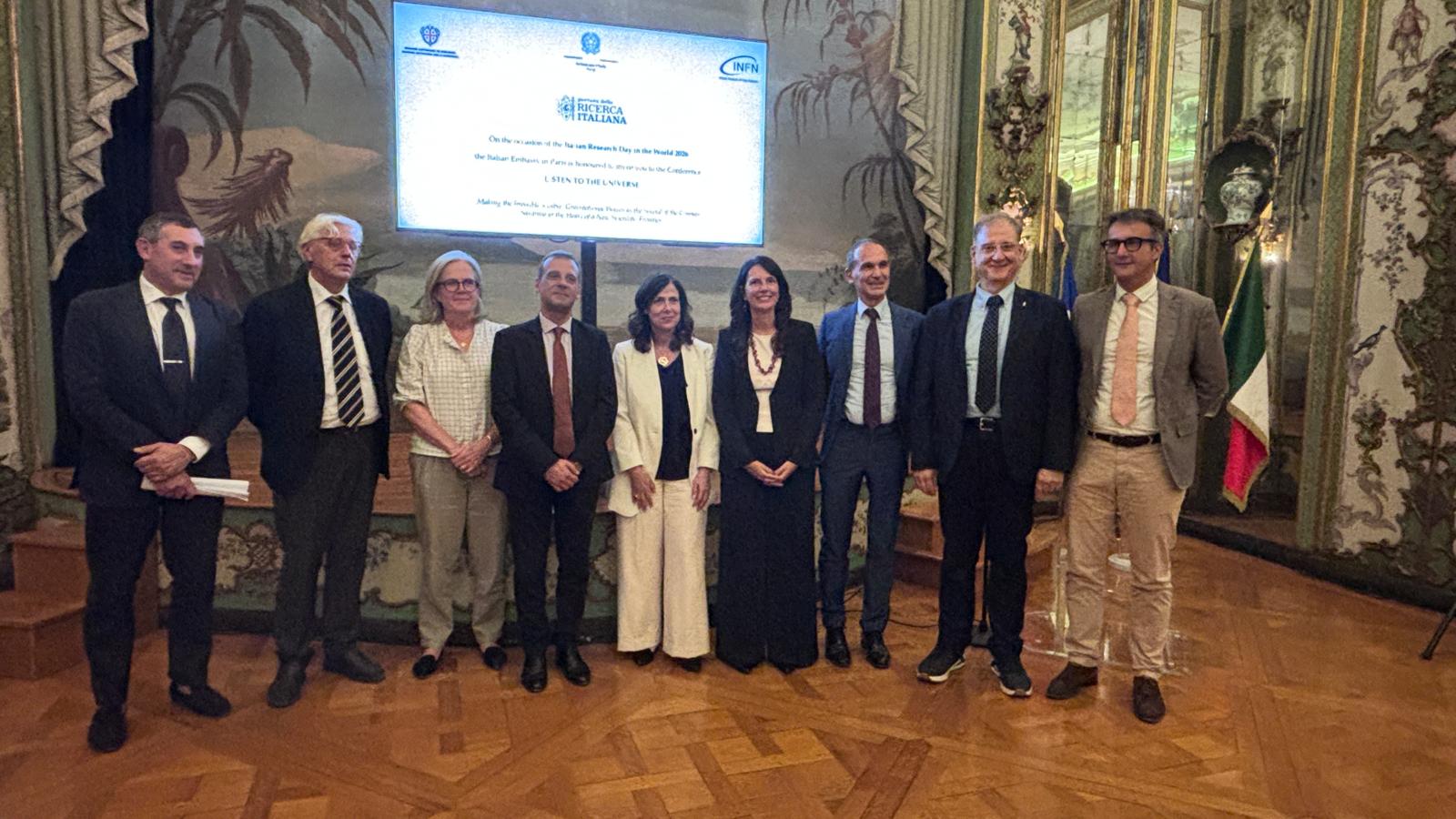
Yesterday, 29 September, on the occasion of the Italian Research Day in the World, a conference was held in Paris focusing on the candidacy of the Sos Enattos area to host the Einstein Telescope (ET) and on the prospects for European scientific collaboration in the field of gravitational waves. The event, entitled “Listening to the Universe. Making the invisible visible: gravitational waves as the ‘sound of the Universe’. Sardinia at the forefront of a new scientific frontier”, took place at the Embassy of Italy in Paris and brought together representatives of the Italian and French scientific communities, institutional representatives and members of several European embassies in France.
The choice to hold the conference in Paris was not accidental. The scientific communities of Italy and France have been collaborating for years on gravitational-wave research, particularly within the Virgo project, the second-generation interferometer located in Cascina, near Pisa. The hope is that this shared body of experience can continue to grow in preparation for the development of ET.
During the meeting, speakers highlighted the international dimension of the project and the need to build broad European cooperation capable of bringing together scientific, technological and infrastructural expertise. In this context, the collaboration between Sardinia and the Free State of Saxony was also mentioned. The partnership was formalised through an agreement to support a joint candidacy for the realisation of the Einstein Telescope in the 2L configuration.
The meeting was attended by President of the Sardinia Region Alessandra Todde, who highlighted France’s role as a strategic partner in the European ET project; Stefano Matthias Panebianco, researcher at the Centre National de la Recherche Scientifique (CNRS) and representative of the French Ministry for Research and Space; Marie Anne Bizouard, CNRS researcher and member of the Virgo project; Patrice Verdier, from the French Ministry for Research and a member of the ET Board of Governmental Representatives; Fulvio Ricci, from Sapienza University of Rome and former spokesperson for the Virgo project; Michele Punturo, researcher at INFN and former coordinator of the Einstein Telescope scientific collaboration; and Marica Branchesi, astrophysicist and professor at the Gran Sasso Science Institute.