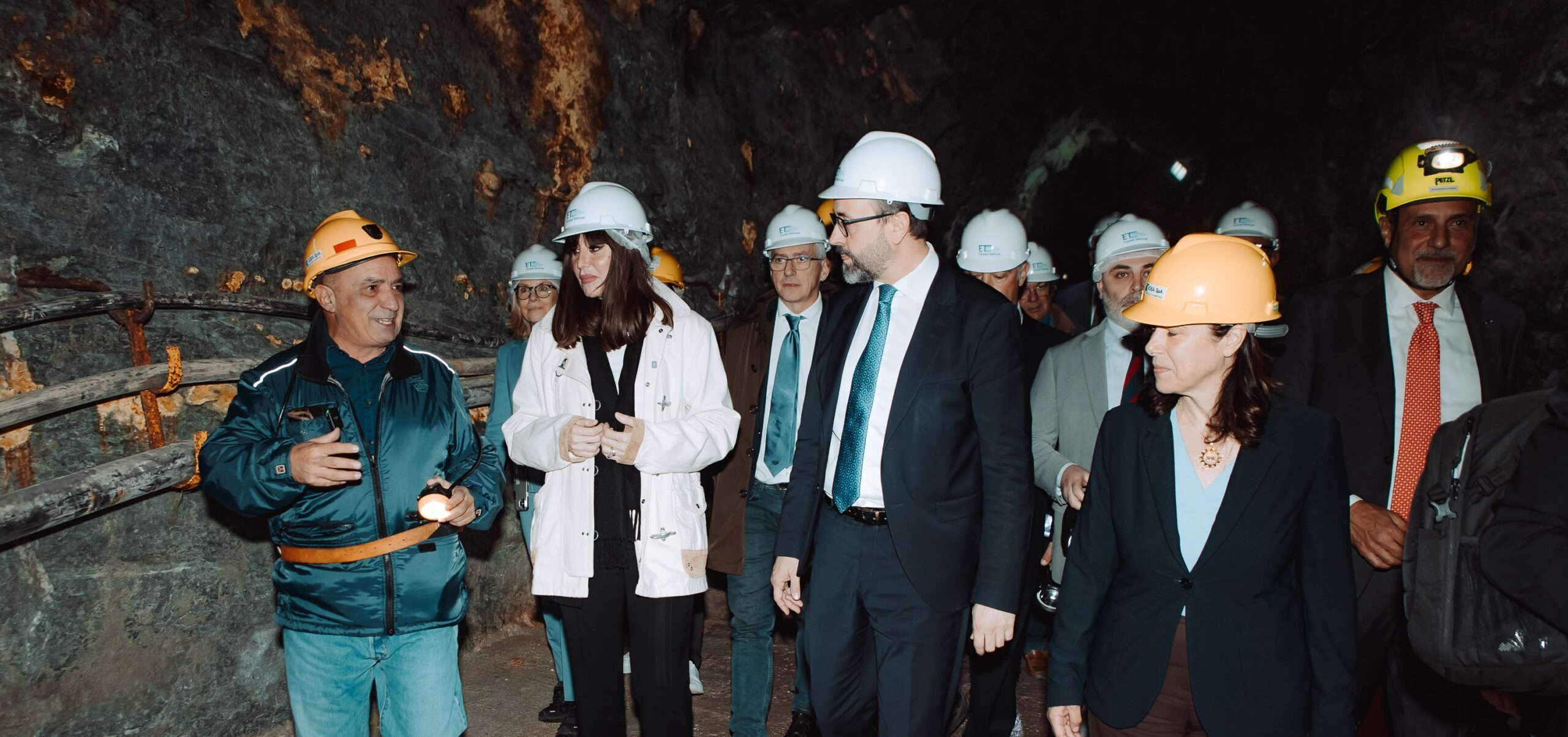
The Italian Minister of University and Research, Anna Maria Bernini, and the Minister of Science of the Free State of Saxony, Sebastian Gemkow, visited the Sos Enattos mining site in Lula (Nuoro), Sardinia, which is Italy’s candidate to host the future Einstein Telescope (ET) gravitational-wave observatory. The visit strengthens the joint candidacy by Sardinia and Saxony, which envisages the construction of two interferometers in their respective territories, according to a configuration known as the “double-L” configuration.
The joint candidacy by Sardinia and Saxony is based on the scientific expertise and geological characteristics of the two regions, which offer particularly favourable conditions for the construction of Einstein Telescope. The proposal is further supported by the findings of the recent Geometry Comparison Report, a study carried out by more than 200 experts to compare possible configurations for the infrastructure and provide technical input to ET’s Board of Governmental Representatives, the body responsible for making the final site selection. The report highlights the advantages of the double-L configuration over the triangular geometry in terms of scientific opportunities, lower instrumentation costs and project management.
«I am very pleased that Minister Gemkow has accepted my invitation to visit Sos Enattos, the site that Italy considers the best option for hosting Einstein Telescope, also in the perspective of a double-L configuration, which is likewise considered preferable by the scientific community», said Anna Maria Bernini, Minister of University and Research.
«This outcome confirms the strength of the joint candidacy submitted by Saxony and the Italian region of Sardinia, which is based precisely on this approach. Building parts of Einstein Telescope both in the Lusatia region of Saxony and in Sardinia further strengthens the cross-border dimension of this unique project, fully embodying the spirit of the European ideal», said Sebastian Gemkow, Minister of Science of the Free State of Saxony.
«The Region has demonstrated, together with Minister Bernini and the Government, that teamwork delivers results», said Alessandra Todde, President of the Autonomous Region of Sardinia. «We have shown that by working together, pursuing this candidacy and promoting both the Region and its territory, we can achieve our goals. This is a project shared by Sardinia and Saxony; it is a European project. It represents a unique opportunity for us», Todde concluded.
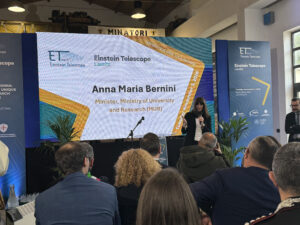
Minister Anna Maria Bernini’s speech at the event ‘Saxony and Sardinia: two sites for a unique European research infrastructure’, held at the Mining Museum in Sos Enattos.
«The meeting here at Sos Enattos between Ministers Gemkow and Bernini, in the presence of President Todde, is an important sign of the commitment of Italian, Sardinian and Saxon institutions to working together to turn Einstein Telescope into reality. It is currently one of the world’s most ambitious scientific projects», said Antonio Zoccoli, President of the National Institute for Nuclear Physics (INFN). «We are building an outstanding team capable of bringing together scientific, technological and industrial expertise to create a one-of-a-kind distributed European infrastructure».
«Einstein Telescope is an extraordinary scientific challenge that requires multidisciplinary expertise and strong collaboration between research institutions and public authorities. The ability to detect even the tiniest tremors of the Earth, with contributions from geology, geophysics and INGV researchers, will be essential to listening for the most distant signals in the Universe. This project demonstrates how research and major discoveries emerge from the sharing of knowledge and collective effort», said Fabio Florindo, President of the National Institute for Geophysics and Volcanology (INGV).
«The quiet underground environments of Sardinia and Saxony are an extraordinary resource for science: only in this silence will Einstein Telescope be able to detect the faintest signals from extreme events in the Universe», said Roberto Ragazzoni, President of the National Institute for Astrophysics (INAF). «Today’s meeting represents another step towards the realisation of this major scientific and technological endeavour, to which INAF contributes through multimessenger astronomy: underground, to listen for the merger of two stars; above ground, to observe their light».
Cooperation between Sardinia and Saxony was formalised through a declaration of intent signed in Rome last January by Sardinian President Alessandra Todde and Minister Gemkow, followed by a scientific agreement signed in Nuoro on 17 July by the main Italian and German research institutions involved in the project.
The visit to the Sos Enattos mining site was attended by Ministers Bernini and Gemkow, Sardinian President Alessandra Todde, and representatives of the Italian and German scientific delegations. The two Ministers also took part in the meeting “Saxony and Sardinia: Two Sites for a Unique European Research Infrastructure”, held at the Mining Museum. Speakers included Lula Mayor Mario Calia, former Sos Enattos mine director Gianluca Loddo, INFN President Antonio Zoccoli, INAF President Roberto Ragazzoni, and INGV President Fabio Florindo.