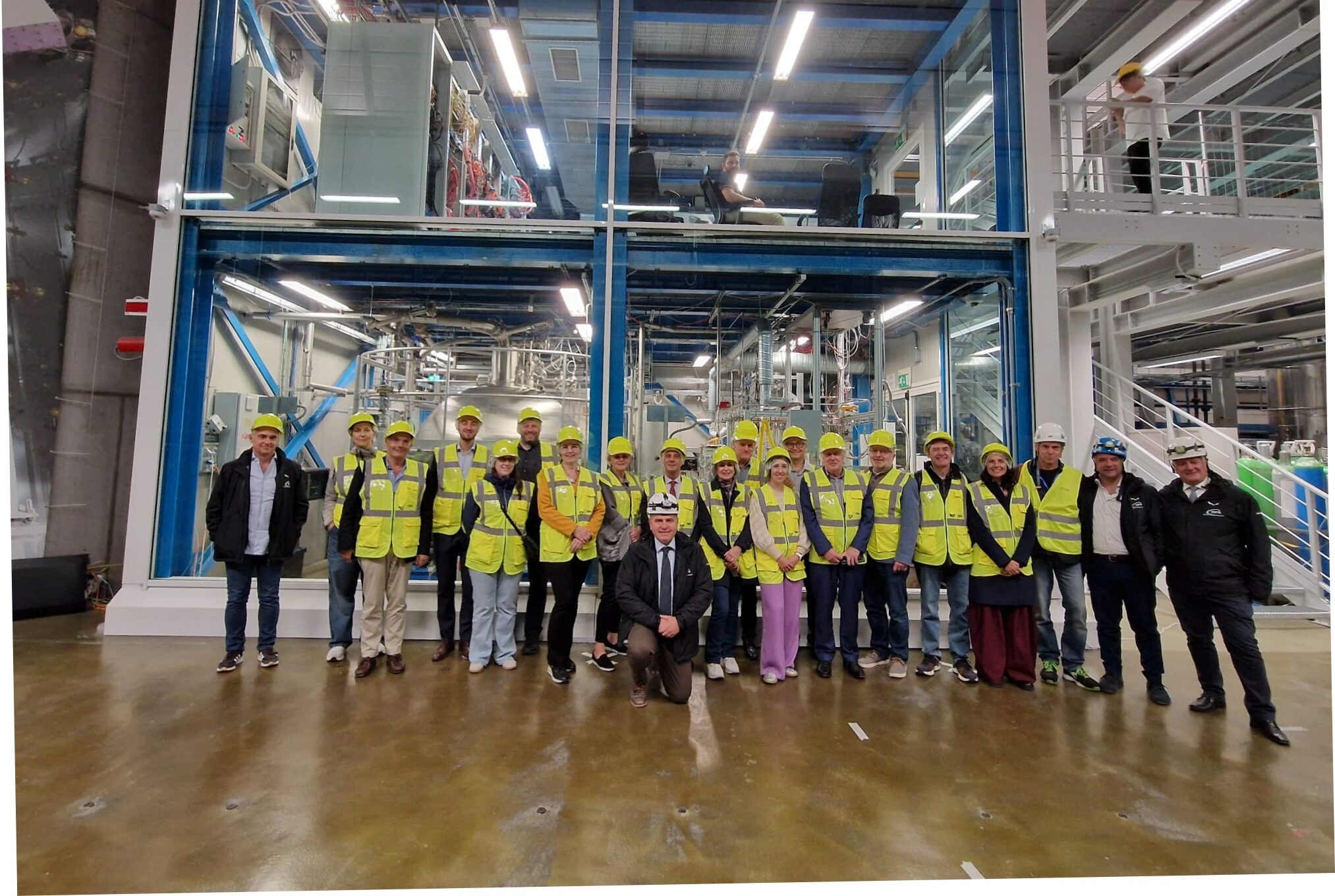
Yesterday afternoon, Tuesday, 20 October, members of the Einstein Telescope (ET) Board of Governmental Representatives (BGR) visited the Gran Sasso National Laboratories of the Italian National Institute for Nuclear Physics (INFN), accompanied by Marco Pallavicini, a member of the INFN Executive Board, and Ezio Previtali, Director of the Gran Sasso National Laboratories.
The visit, preceded by a tour of the Gran Sasso Science Institute in L’Aquila, was organised on the occasion of the BGR’s regular meeting, scheduled for today in Rome at the headquarters of the Accademia Nazionale dei Lincei. The BGR is responsible for coordinating relations between the governments of the countries involved in ET and the funding agencies.
«The INFN Gran Sasso National Laboratories are currently the world’s leading operational underground research facility dedicated to astroparticle physics. Their history and scientific and technological activities demonstrate INFN’s ability not only to design, build and operate major research infrastructures, but also to develop underground facilities of extraordinary complexity», emphasises Antonio Zoccoli, President of INFN. «This wealth of experience and expertise – he continues – serves as an international benchmark and confirms the role INFN can play in major frontier research projects, such as Einstein Telescope, the next-generation gravitational-wave detector».
A key feature shared by ET and the Gran Sasso National Laboratories is that ET will also be a major underground research infrastructure, located at a depth of between 200 and 500 metres. This setting will provide a high degree of isolation from vibrations caused by both seismic waves and human activities, significantly increasing the experiment’s sensitivity compared with that of current gravitational-wave observatories.
The BGR includes representatives from Belgium, Croatia, France, Germany, Greece, Italy, the Netherlands, Poland, the United Kingdom and Spain, with Austria participating as an observer. The board is also responsible for making the final decision on the site selection for ET (expected in 2027). Italy is a candidate to host the observatory in the area surrounding the disused Sos Enattos mine in the Nuoro region, in Sardinia.
Einstein Telescope will be one of the most important research infrastructures to be built in Europe over the coming years. In addition to Italy, the other candidate sites are the Meuse-Rhine Euroregion, on the border between the Netherlands, Belgium and Germany, and the Lusatia site in Saxony, Germany.
Two alternative configurations are currently being considered for ET: a single triangular detector, with arms approximately 10 kilometres long, to be built at one site; or two twin L-shaped interferometers, each with 15-kilometre-long arms, to be constructed at two separate sites at least 1,200 kilometres apart. On 7 October, a report comparing the two possible detector geometries was submitted to the BGR. The report analyses the advantages and disadvantages of the two configurations and provides an assessment independent of the candidate sites.
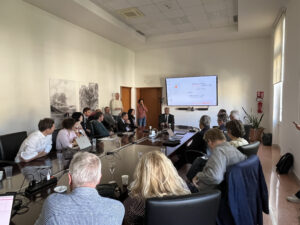
BGR visit to the Gran Sasso Science Institute.