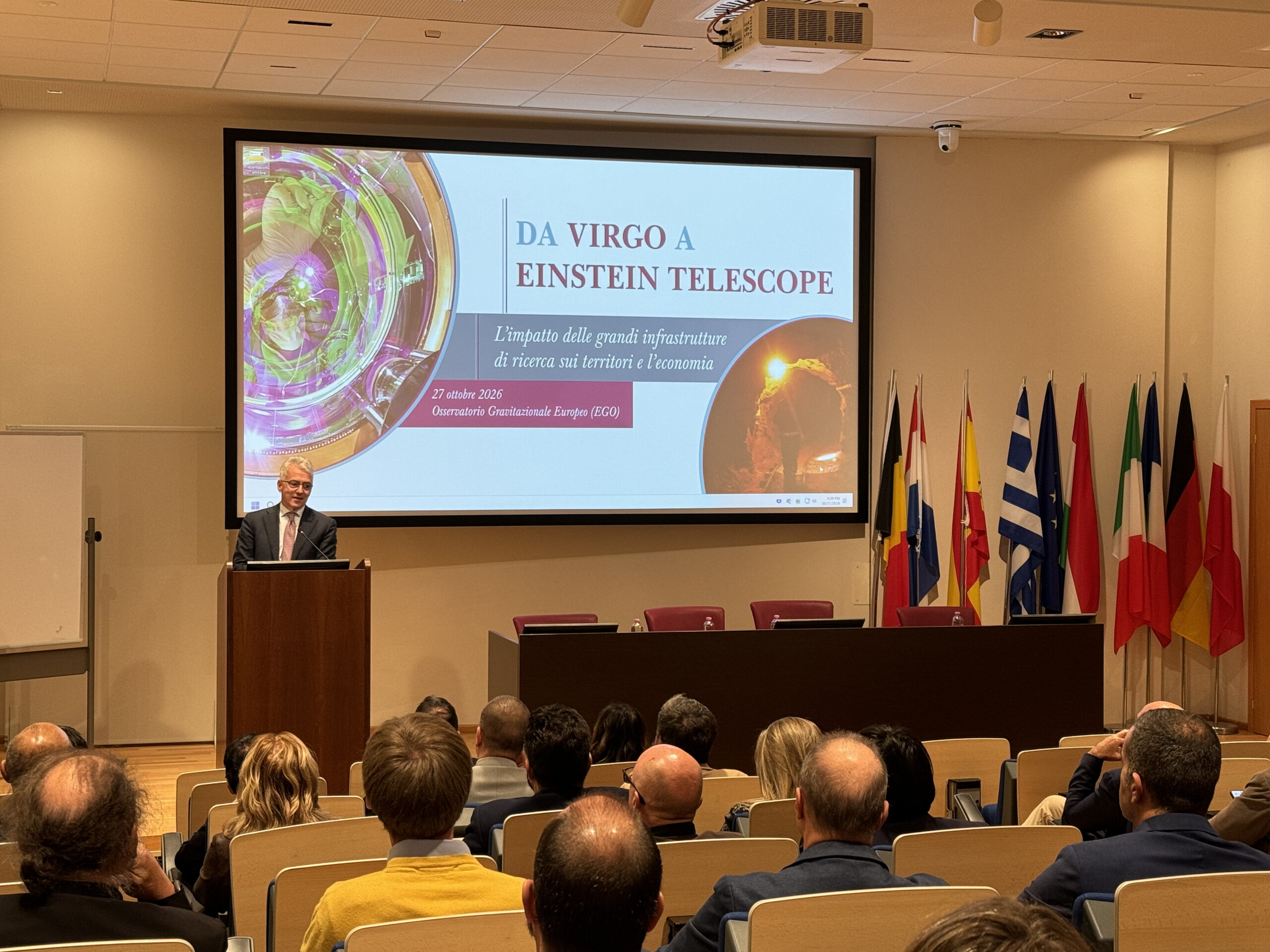
Source: European Gravitational Observatory (EGO), 27/10/26
The meeting “From Virgo to Einstein Telescope: the impact of major research infrastructures on local communities and the economy” was held today at the European Gravitational Observatory (EGO) in Cascina, with the participation of Eugenio Giani, President of the Tuscany Region, and Alessandra Todde, President of the Autonomous Region of Sardinia. The aim was to highlight how the expertise and scientific excellence developed in Tuscany through the Virgo interferometer can strengthen the Italian candidacy to host the next major gravitational-wave detector, Einstein Telescope (ET), in Sardinia.
Research into gravitational waves, extremely faint signals generated by cosmic “earthquakes” millions or billions of light-years from Earth, has required technological advances, scientific excellence and the extraordinary determination of generations of scientists over more than thirty years. The historic discovery of these waves, recognised with the Nobel Prize the following year, was announced on 11 February 2016 simultaneously in the United States, at the National Science Foundation headquarters in Washington, and at the European Gravitational Observatory in Cascina, home to the Virgo experiment. Virgo is the only detector in Europe capable of detecting gravitational waves and, alongside the two US-based LIGO interferometers, was one of the key players in the long search that led to the remarkable discovery announced in 2016. This historic achievement ushered in a new era of astronomy, known as gravitational-wave astronomy, which now allows us to listen to the echoes of the most extreme cosmic events, such as black hole and star mergers. It has opened up a new way of studying the Universe, transforming our understanding of the cosmos.
Today, thousands of researchers at institutions and universities around the world are working in this field, while the European scientific community is preparing to build the next major gravitational-wave observatory: Einstein Telescope.
ET will be a large underground research infrastructure housing a detector with arms four or five times longer than those of Virgo. Italy is a candidate to host it in Sardinia, in the area of the disused Sos Enattos mine, in the Nuoro region. By taking the technologies developed for Virgo and LIGO to a much larger scale and a significantly higher level of sensitivity, ET will be able to observe a volume of the Universe at least a thousand times greater, with an extraordinary impact on scientific knowledge.
A world-class research infrastructure such as ET will naturally have a significant economic impact on its host region. The construction phase alone is estimated to require an investment of approximately €2 billion, generating a business volume almost four times that amount and providing full-time employment for several thousand people over the ten years required to build it. An estimated 70% of the resulting economic activity will take place at regional level, involving sectors such as construction, mechanical engineering, technical and engineering services, geology, transport, hospitality and many others. An even more significant and long-lasting impact will come from training and developing highly qualified personnel in STEM disciplines, while also enhancing the region’s cultural identity through the innovative nature of its scientific and technological research.
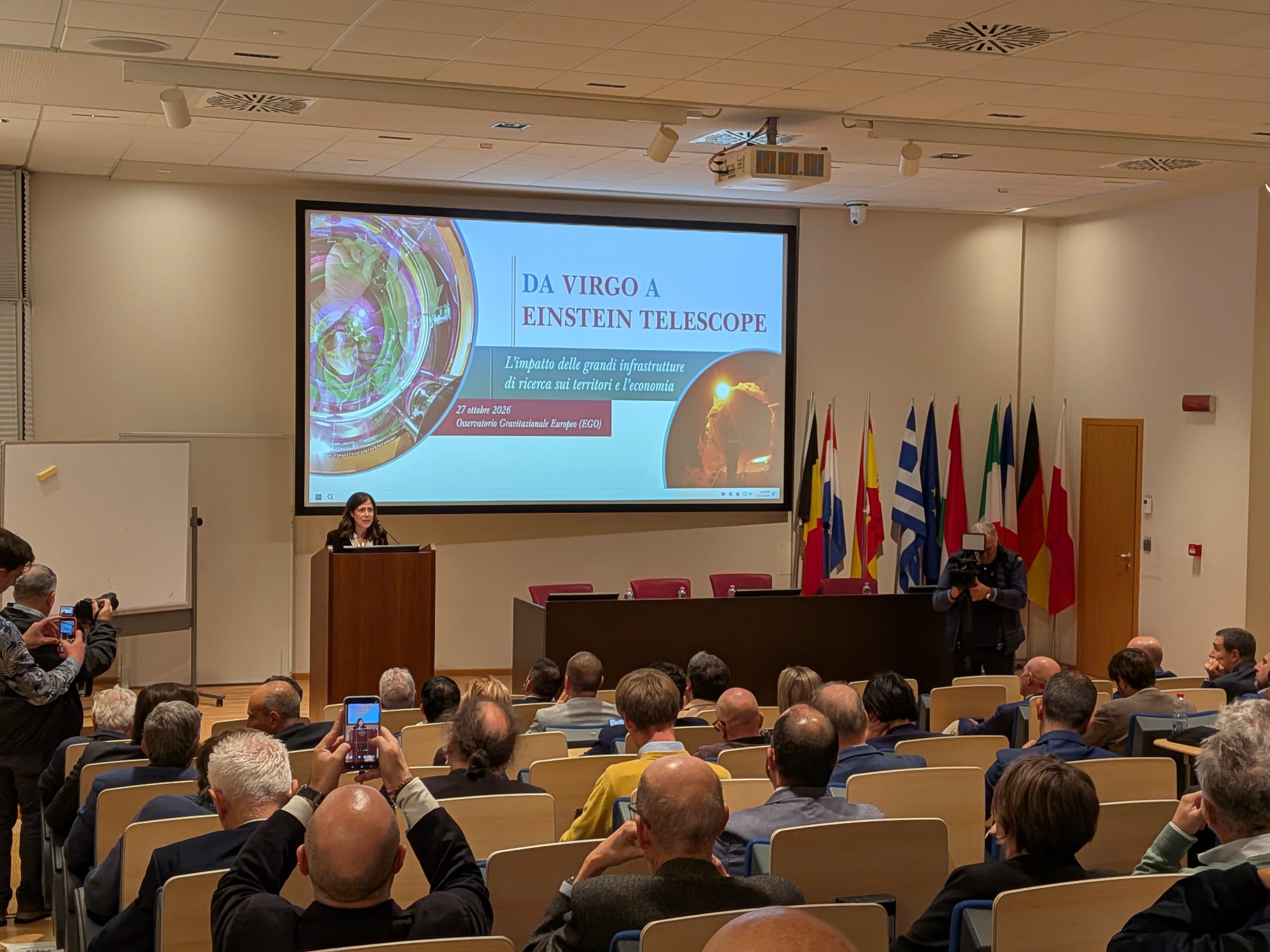
Remarks by Alessandra Todde, President of the Sardina Region.
«The Italian candidacy to host Einstein Telescope, supported by the Italian Government, the Ministry of University and Research (MUR) and the Ministry of Foreign Affairs and International Cooperation (MAECI), has made it possible in recent years to establish research and development laboratories for ET technologies, also thanks to funding from Italy’s National Recovery and Resilience Plan (NRRP), through close collaboration between INFN and universities across several Italian regions», affirms Antonio Zoccoli, President of the National Institute for Nuclear Physics (INFN). «Synergies and coordination among these efforts at regional level can play a decisive role in strengthening both Italy’s candidacy and the project as a whole. Tuscany, home to the Virgo interferometer; Sardinia, which aims to host Einstein Telescope; and Umbria, which recently inaugurated the CAOS laboratory (Centre for Applications of Gravitational Waves and Seismology), are all key players in this major European initiative and in the opportunities it offers for our country’s development».
«EGO and Virgo owe their existence and development to international collaboration between institutions and universities from several countries, particularly Italy, France, the Netherlands and Belgium, and to the work of more than a thousand researchers from across Europe», says Massimo Carpinelli, Director of EGO. «A scientific infrastructure with such international standing is an asset for the region that hosts it, Tuscany, as well as for the Italian and European research systems as a whole. EGO and Virgo’s expertise and excellence in gravitational-wave research play a strategic role in strengthening Sardinia’s bid to host Einstein Telescope. More broadly, they are crucial to the success of the ET project and to ensuring Europe’s leadership in this cutting-edge field».
Following a tour of the facility, the meeting opened with welcome addresses by Eugenio Giani, President of the Tuscany Region; Alessandra Todde, President of the Region of Sardinia; Antonio Zoccoli, President of INFN; and Thomas De Luca, Regional Councillor for Energy and the Environment, representing Stefania Proietti, President of the Umbria Region, who was unable to attend. The scientific excellence and cutting-edge technology of research infrastructures, along with their economic and social impact, were the focus of presentations by Massimo Carpinelli, Director of the European Gravitational Observatory (University of Milano-Bicocca); Michele Maggiore, international spokesperson for the Einstein Telescope scientific collaboration (University of Geneva); Pia Astone, an INFN researcher and member of the Virgo Collaboration; and Monique Bossi, Infrastructure Manager for the ETIC project and subsequently MITI, both of which support Einstein Telescope and the Italian candidacy.
«Tuscany is proud to host this event at the European Gravitational Observatory (EGO) in Cascina, a world-leading research centre that is home to the Virgo experiment, unique in Europe and one of only four of its kind worldwide. This region has a wealth of expertise, research capabilities and outstanding technical and scientific know-how, providing an extraordinary driver of innovation and economic development. Our challenge is to make the most of this ecosystem by firmly supporting Sardinia’s candidacy to host Einstein Telescope», adds Eugenio Giani. «Synergy between the two regions is essential. We are convinced that Sardinia’s candidacy, strengthened by Tuscany’s support and expertise, can not only bring this European project to Italy but also represent a historic opportunity to further strengthen Virgo’s presence and role, as well as scientific research itself, right here in Tuscany. We will continue to invest in research and major infrastructures because we believe science is a driving force for growth and territorial cohesion».
«The experience gained through Virgo, built on the work of INFN and its French partners, together with the commitment of the Tuscany Region, is a fundamental reference point for Sardinia’s candidacy to host Einstein Telescope. Tuscany is a close partner to which we in Sardinia feel deeply connected, and it demonstrates how investment in knowledge and technology can create opportunities for local communities and businesses», highlights Alessandra Todde. «For Sardinia, Einstein Telescope is a project capable of transforming the island’s future by building on a research system that already benefits from significant expertise and infrastructure. We want our region to play a leading role in research and innovation in Italy and Europe. I am convinced that collaboration between Sardinia and Tuscany, also reflected in our shared efforts at European level, can make a decisive contribution to this ambition. Sharing knowledge, strengthening expertise and fostering scientific and technological exchanges will reinforce the candidacy and create development opportunities for both regions».
«The Einstein Telescope project, built on essential collaboration between Sardinia, Tuscany and Umbria, demonstrates how crucial cooperation is to Italy’s bid to host ET at the Sos Enattos site. It shows that a world driven by individualism and domination, by ‘me’ and ‘mine’, cannot generate, grow or bear fruit», concludes Stefania Proietti. “For Umbria, with its CAOS laboratory, an absolute leader in the field of physics, the ET challenge is one of our top priorities as we work to shape a future that is already taking form today».