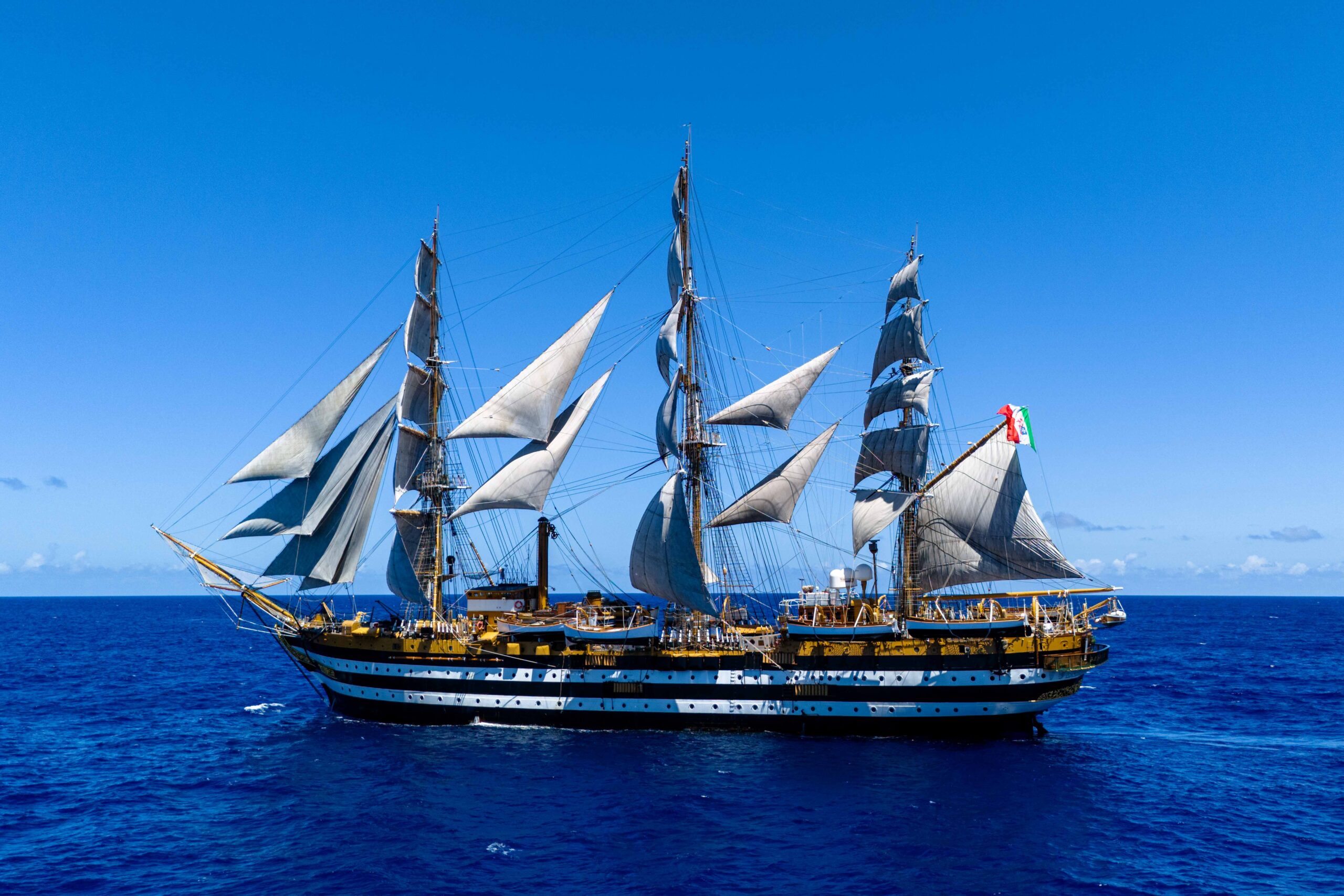
A meeting to present the Italian commitment in the field of multi-messenger astronomy, ranging from optical and radio telescopes to current and future gravitational-wave observatories: on Friday, 22 May, the training ship Amerigo Vespucci, a symbol of Italian excellence worldwide, which stopped in Santa Cruz de Tenerife as part of the “Amerigo Vespucci World Tour – North America Campaign 2026” hosted “Islas entre las ondas”, a round table organized by the Italian Vice Consulate in Arona, with guidance from the scientific office of the Italian Embassy in Madrid. The event brought together researchers and representatives from the scientific and technological community of the Canary Islands, as well as many physics and astronomy enthusiasts.
At the heart of the event was the theme of “islands among waves”: the Canary Islands and Sardinia, which offer ideal environmental and scientific characteristics for hosting some of Europe’s most advanced astrophysics facilities. The Canary Islands host facilities mangaed by the National Institute for Astrophysics (INAF), including the Telescopio Nazionale Galileo (TNG), a key reference for optical astronomy, and the ASTRI mini-array, a network of telescopes dedicated to the study of gamma rays. Sardinia, on the other hand, is home to the Sardinia Radio Telescope (SRT) and has been proposed by Italy, with Spain’s support, as a candidate site to host the Einstein Telescope (ET), the future European gravitational-wave detector.
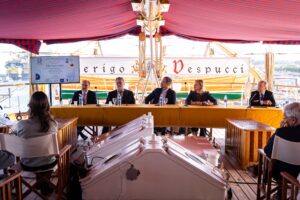
A moment from the roundtable discussion “Islas entre las ondas.
The Einstein Telescope itself, whose Italian candidacy is coordinated by the National Institute for Nuclear Physics (INFN), was one of the central topics of the meeting. The project represents one of the most ambitious European scientific infrastructures of the coming decades and aims to revolutionize the study of the universe through the observation of gravitational waves with unprecedented sensitivity, enabling the exploration of cosmic phenomena that are currently invisible. The discussion also explored the role of multi-messenger astronomy in addressing the great mysteries of the cosmos: only by observing the sky through multiple “eyes” and messengers, from radio waves to gravitational waves, will we be able to answer the major questions of modern science.
The round table, moderated by Sergio Scopetta, Scientific Attaché at the Embassy of Italy in Madrid, featured Silvia Casu, an INAF researcher working on SRT; Eugenio Coccia, Director of the Institut de Física d’Altes Energies (IFAE) in Barcelona and expert in gravitational-wave research; Adriano Ghedina, Director of TNG; and Alberto Masoni, INFN research director and Sardinian coordinator of the Einstein Telescope Infrastructure Consortium (ETIC).
The event, opened by institutional greetings from Vice Consul Gianluca Cappelli Bigazzi and the ship’s commander, captain Nicasio Falica, represented an important opportunity for international promotion of the Einstein Telescope project and the Italian candidacy to host it in Sardinia. The initiative also helped strengthen the interest of the Spanish scientific community in the project, in continuity with the agreement signed in 2024 between Italy and Spain supporting the Italian candidacy.
Image credit: Marina Militare.