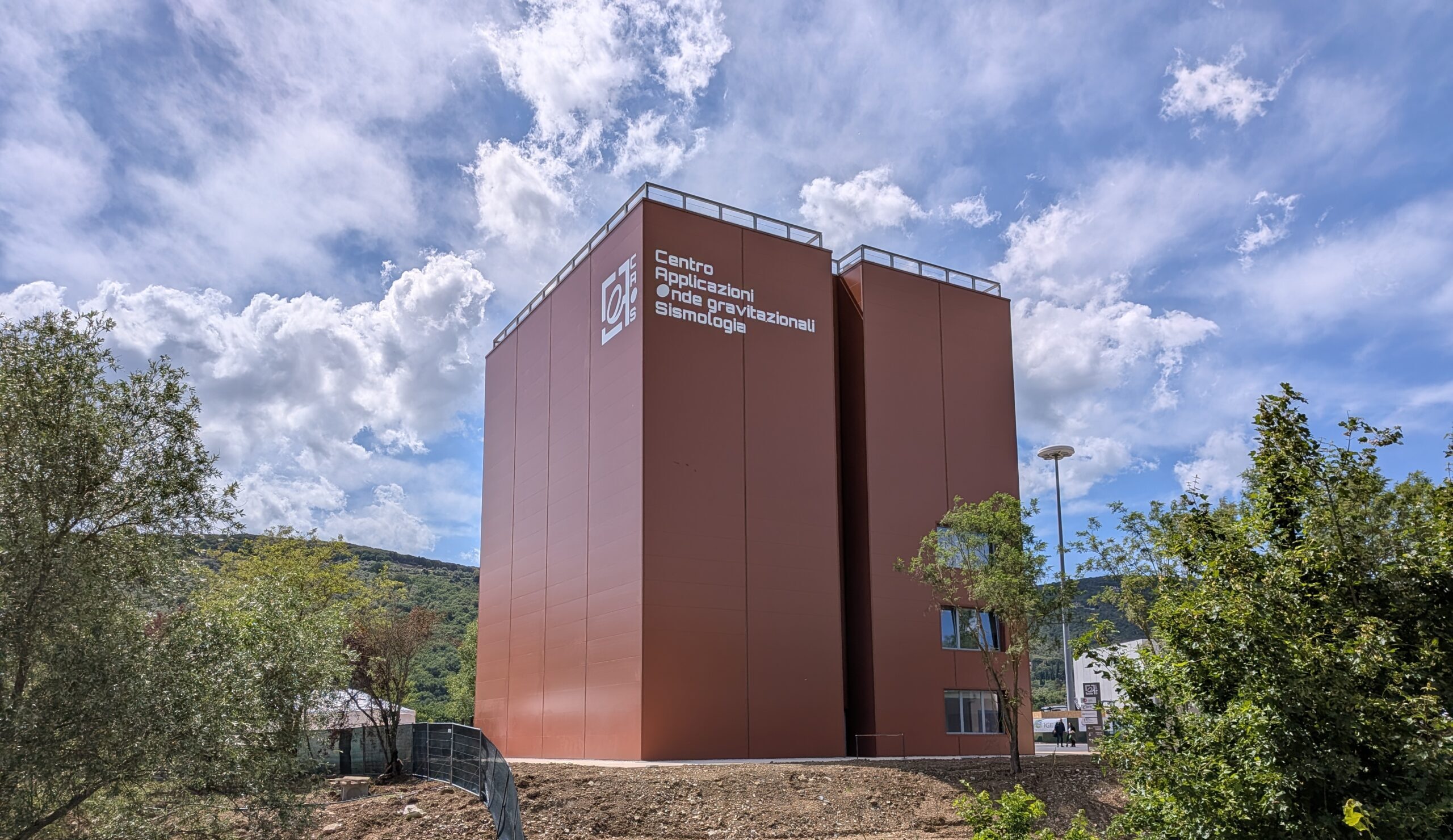
On Thursday, May 14, 2026, the international CAOS laboratory – Center for Applications on Gravitational Waves and Seismology was inaugurated at the Engineering Campus of the University of Perugia. The new research infrastructure, established within the Department of Physics and Geology, is dedicated to the development of advanced technologies for the study of gravitational waves and seismology. The initiative was held under the patronage of the Region of Umbria.
The laboratory was created on the initiative of the National Institute for Nuclear Physics (INFN) within the framework of the ETIC – Einstein Telescope Infrastructure Consortium project, funded through Mission 4 of Italy’s National Recovery and Resilience Plan (NRRP) and coordinated by the Ministry of University and Research (MUR). The project was developed in close collaboration with the University of Perugia, the Department of Physics and Geology, the INFN Perugia section, and the scientific community involved in the Einstein Telescope (ET), the major European infrastructure for gravitational-wave research that Italy is proposing to host in Sardinia, in the Sos Enattos area near Nuoro.
The inaugural ceremony opened with a congratulatory video message from Italy’s Minister of University and Research, Anna Maria Bernini. Participants included the Rector of the University of Perugia, Massimiliano Marianelli; the President of the Region of Umbria, Stefania Proietti; Raffaele Marras representing the President of the Region of Sardinia, Alessandra Todde; the Mayor of Perugia, Vittoria Ferdinandi; the President of INFN, Antonio Zoccoli; and representatives of national and international scientific institutions, including Nobel Prize laureate Takaaki Kajita.
A session dedicated to collaborations and future perspectives followed, featuring Takaaki Kajita, Massimo Carpinelli, Director of the European Gravitational Observatory (EGO); Takayuki Tomaru of the National Astronomical Observatory of Japan; Helios Vocca, scientific coordinator of the CAOS Laboratory; and Gabriele Capoccia of the INFN Perugia Section.
In addition to the inauguration of the CAOS laboratory, the city of Perugia is also hosting the 14th international workshop of the KAGRA experiment, the Japanese gravitational-wave observatory, scheduled at Hotel Brufani on Friday, May 16 and Saturday, May 17.
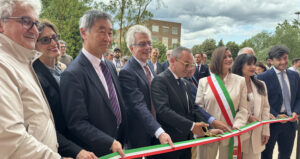
The traditional ribbon-cutting ceremony.
Institutional Statements
Rector of the University of Perugia, Massimiliano Marianelli
«The inauguration of the International CAOS Laboratory represents an achievement of extraordinary importance for the University of Perugia, for the research system, for the territory, and for the entire country, placing us at the center of a research infrastructure of the highest profile, closely connected to the European challenge of the Einstein Telescope. CAOS is a tangible sign of a university that does not merely seek to participate in the great challenges of the present and future, but chooses to play a leading role, directing resources and knowledge toward results of global significance. It is the outcome of a demanding journey, begun by my predecessors, requiring determination, vision, and a profound capacity for collaboration among people, territories, expertise, and institutions.
The project demonstrates in exemplary fashion that advanced research can grow only when it is both rigorous and open, specialized and interdisciplinary, promoting a vision of science as a shared and generative space.
Inaugurating this place today means inaugurating a hope: that knowledge may continue to open new worlds and that science may always remain a common good serving the collective good. I extend my sincere thanks to Minister Anna Maria Bernini and to the representatives of the institutions present for their valuable and active support. My gratitude and best wishes for productive work go to Professor Helios Vocca, the driving force behind this project, to the national and international scientific community gathered here today in such large numbers and with such distinguished representatives, including Nobel Prize laureate Takaaki Kajita, to INFN President Antonio Zoccoli, to the other institutional partners, and to all the researchers involved».
President of the Region of Umbria, Stefania Proietti
«The Region of Umbria looks with great pride upon the inauguration of the International CAOS Laboratory at the Engineering Campus of the University of Perugia, an infrastructure of outstanding scientific value that strengthens the role of our territory within the national and international research landscape. This project represents a concrete example of how collaboration among institutions, universities, and research centers can generate innovation, attract investment, and create new opportunities for development. Umbria’s support for Sardinia’s candidacy to host the Einstein Telescope reflects our determination to play a leading role in major global scientific challenges by combining expertise, vision, and planning capacity. We are confident that our strategic infrastructure will prove decisive in the final decision, which we hope will favor Italy. The CAOS Laboratory is not only an advanced research center but also an investment in the future: a place where talent is nurtured, strategic technologies are developed, and high-level international relationships are built. As a region, we will continue to strongly support initiatives like this, which strengthen the competitiveness of the territory and promote growth based on knowledge and innovation».
President of the Sardinia Region, Alessandra Todde
«The inauguration of the CAOS scientific laboratory is a practical example of the enormous positive impact that the Italian candidacy to host the Einstein Telescope in Sardinia can generate. It is a project capable of transforming the territories involved in every respect: scientific, economic, and cultural. We believe we have the best site and remain confident about the outcome of the candidacy. But regardless of whether ET is ultimately built in Italy, the CAOS laboratory — together with the ET-SunLab research center we are developing in the Sos Enattos area and other infrastructures that will emerge — will strengthen the scientific community, create jobs, help local businesses grow, and generate economic benefits for the communities hosting them».
Mayor of Perugia, Vittoria Ferdinandi
«The inauguration of the international CAOS laboratory is a source of great pride for Perugia. This project confirms the international standing of our university and of the scientific network that, from Perugia, engages with the world’s leading research centers. Investing in research means investing in the future, in knowledge, in opportunities for younger generations, and in the ability of territories to become protagonists in the major global challenges. The Italian candidacy for the Einstein Telescope is a strategic challenge that must unite institutions, universities, and the scientific community, because it represents an extraordinary opportunity for growth for the country».
INFN President Antonio Zoccoli
«The Einstein Telescope gravitational-wave research infrastructure is among the most ambitious scientific projects that Europe will undertake in the coming decades. To support the Italian candidacy to host it and contribute to this scientific and technological challenge, we are creating throughout the country, thanks to the ETIC project funded through the NRRP resources of the Ministry of University and Research, a constellation of cutting-edge laboratories, of which CAOS is one of the flagship facilities. This laboratory is strategically important both for the Italian candidacy and for the realization of the Einstein Telescope itself: here we will build the first prototype of the suspension and optical control systems, among the most complex and decisive elements for the success of one of the greatest scientific enterprises of our time».
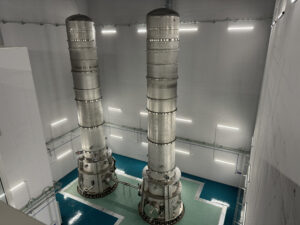
The two vacuum chambers in the CAOS laboratory.
The CAOS Laboratory
The CAOS Laboratory represents a strategic component of the Italian candidacy to host the Einstein Telescope, an international-scale research infrastructure comparable in scientific, technological, and societal complexity to major European projects such as CERN and ITER. Einstein Telescope will apply, on a much larger scale, the technologies currently used in the world’s gravitational-wave detectors: Virgo near Pisa, LIGO in the United States, and KAGRA in Japan.
Included since 2021 in the ESFRI roadmap, the Einstein Telescope is recognized as a strategic priority for European research. A decision regarding its future location is expected by 2027, and Italy strongly supports the candidacy of the Sos Enattos site in Sardinia through significant scientific, technological, industrial, and infrastructural investments, backed by strong institutional commitment at the highest levels.
Within this framework lies the NRRP ETIC – Einstein Telescope Infrastructure Consortium project, the operational arm of the Italian candidacy. CAOS is therefore not conceived as a local support laboratory, but as a key infrastructure where the first prototype of the advanced suspension and optical control systems will be developed. The laboratory was established through collaboration among the University of Perugia, National Institute for Nuclear Physics, and European Gravitational Observatory, with an initial total investment exceeding €10 million. Of this amount, €7 million comes from NRRP funds allocated to the ETIC project under Mission 4 coordinated by MUR, while the remainder derives from MUR “Departments of Excellence” funding, University of Perugia funds, and a strategic Italy–Japan MUR project. The national scientific coordination of ETIC is entrusted to Michele Punturo, INFN research director and former international coordinator of the Einstein Telescope scientific collaboration. Helios Vocca, Principal Investigator of ETIC for the University of Perugia, coordinates the CAOS Laboratory.
Science for Everyone: Saturday Evening Event at SanFra
As part of the initiatives connected with the inauguration, on Saturday, May 16 at 9:00 PM, the Auditorium San Francesco al Prato (SanFra) in Perugia will host the public event “The Music of Einstein”, conceived by Psiquadro and National Institute for Nuclear Physics in collaboration with the University of Perugia and under the patronage of the Municipality of Perugia.
The event, with free admission, will be held in Italian and English with simultaneous translation services. It will feature a dialogue between Takaaki Kajita, Nobel Prize laureate in Physics 2015 and principal investigator of the KAGRA project, and Pia Astone, INFN Rome research director and member of the Virgo and Einstein Telescope collaborations. The discussion will be moderated by Matteo Serra, scientific journalist at INFN.
The evening will also feature musical performances by Giovanni Viola, a young violinist from Voghera, who will perform with a precious violin once owned by Albert Einstein during the period in which the scientist lived in Italy.