Source: INFN, 06/05/2026
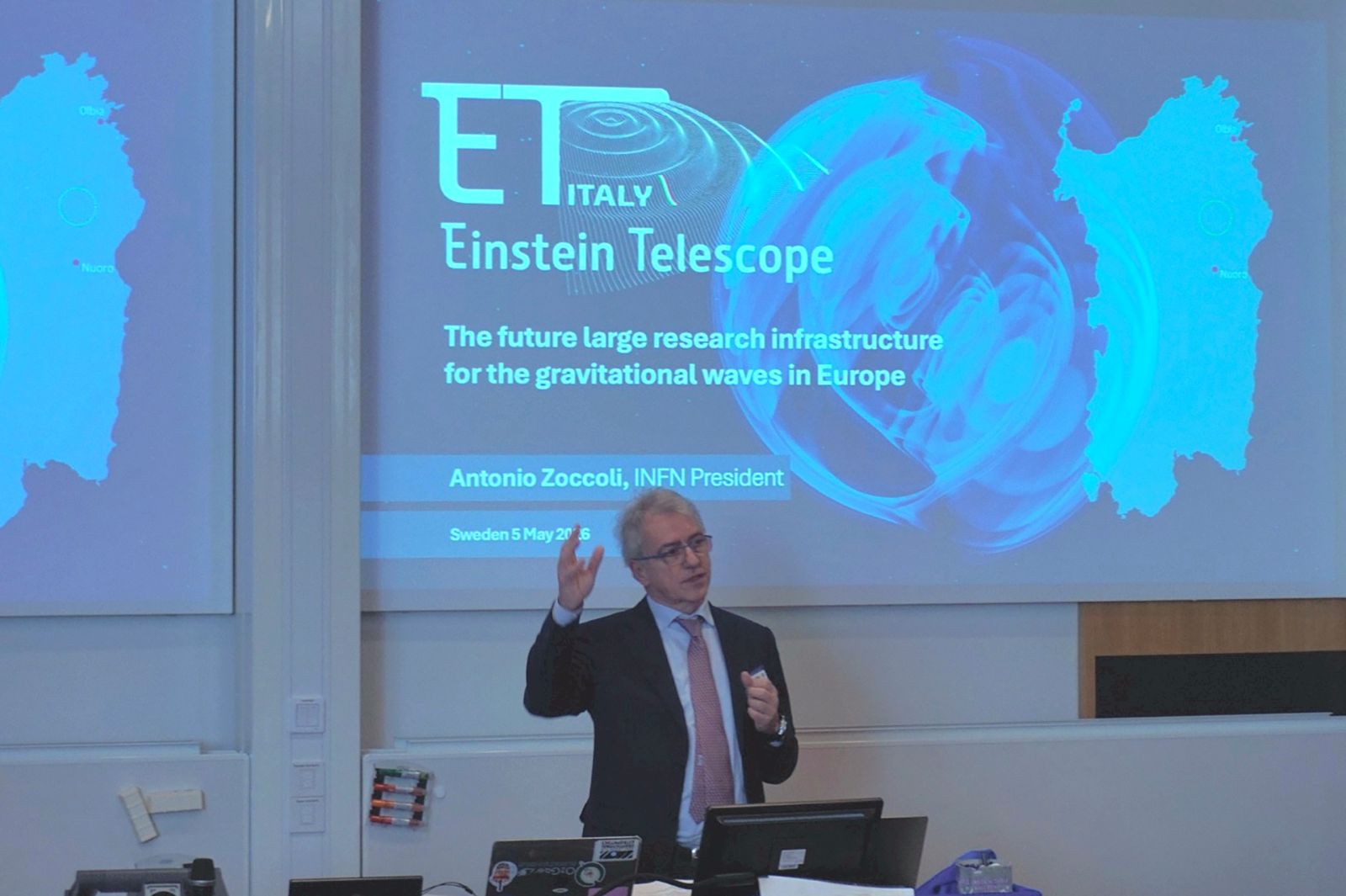
A two-day workshop focused on science and technology, aimed at fostering new collaborations between Italy and Sweden in the field of gravitational wave research, was organized on May 4–5 in Stockholm by the KTH Royal Institute of Technology and the Italian Embassy in Sweden. The event, entitled “The Einstein Telescope Project and Beyond: Science and Technology for Future Gravitational Wave Detectors”, took place at the KTH Royal Institute of Technology and was promoted to connect Italian and Swedish research communities active in the fields of control systems, quantum optics, photonics, detector commissioning, machine learning, and fundamental physics. The goal was to accelerate technological development pathways relevant to future scientific projects dedicated to the study of gravitational waves, including the Einstein Telescope, the large-scale research infrastructure that Italy has proposed to host in Sardinia, and LGWA (Lunar Gravitational Wave Antenna), a project for a lunar gravitational wave detector.
The program featured contributions from institutional representatives of KTH, Chalmers University of Technology, Stockholm University, Stockholm School of Economics, Nordita, INFN (National Institute for Nuclear Physics), INAF (National Institute for Astrophysics), INGV (National Institute of Geophysics and Volcanology), GSSI (Gran Sasso Science Institute), the University of Trento, the University of Camerino, the University of Birmingham, RISE Research Institutes of Sweden, the Swedish Research Council (Vetenskapsrådet), as well as members of the Einstein Telescope and LGWA scientific communities. Among the Italian participants were INFN President Antonio Zoccoli, INAF President Roberto Ragazzoni, INGV President Fabio Florindo, INAF Scientific Director Isabella Pagano, INFN Executive Board representative for the Einstein Telescope project Marco Pallavicini, and LGWA project coordinator and Einstein Telescope collaboration member Jan Harms.
The two-day program was developed through the coordination of Vaishali Adya of the KTH Royal Institute of Technology and Augusto Marcelli, Scientific Attaché at the Italian Embassy in Sweden. It combined invited institutional talks, short technical and scientific presentations, round tables, and workshop-style discussions. The structure of the event was designed to highlight concrete technical challenges and strengthen ties among Swedish universities and institutions, agencies, and industry partners with Italian and broader European counterparts. Scientific topics addressed included quantum optics and squeezing techniques, photonics, detector commissioning, machine learning, and control systems for gravitational wave detectors. As part of the event, a visit was also organized to GE HealthCare laboratories in Stockholm, providing an opportunity to explore the latest developments in clinical photon-counting computed tomography and the progress of the European initiative 1MICRON, coordinated by Mats Danielsson of KTH and, for INFN, by Manuel Da Rocha Rolo. The initiative is dedicated to advancing medical imaging and surgical diagnostics through the integration of cutting-edge silicon CMOS sensor technologies with innovative phase-contrast X-ray imaging systems.
The event was connected to the Italian Research Day in the World 2026, an initiative promoted by the Italian Ministry of Foreign Affairs and International Cooperation (MAECI) and the Ministry of University and Research (MUR), aimed at highlighting the contributions of Italian researchers working abroad and showcasing Italy’s commitment to science, technology, and innovation.