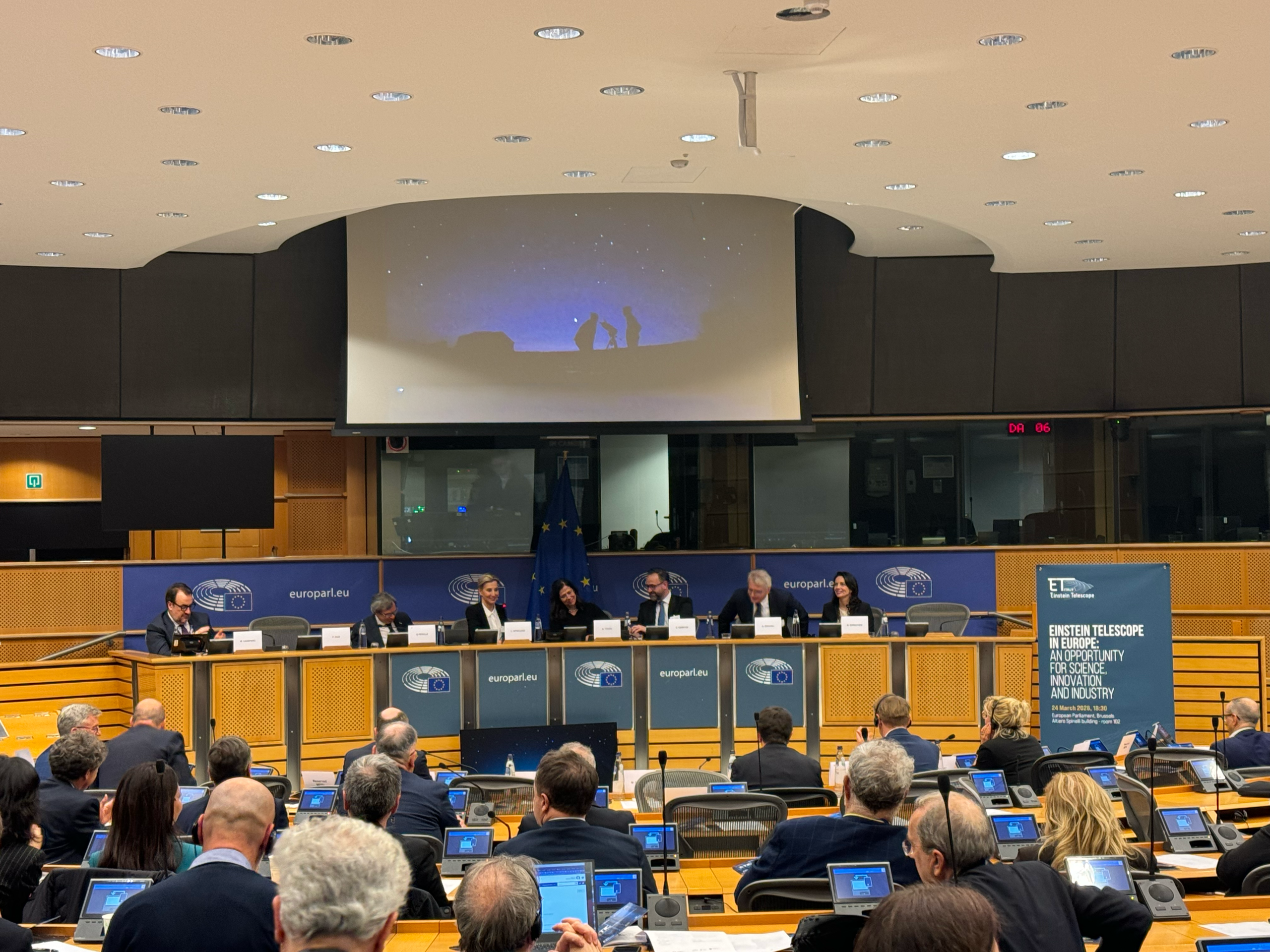
Yesterday, Tuesday March 24, the Italian candidacy to host the Einstein Telescope (ET) was the focus of a conference held at the European Parliament in Brussels, at the Altiero Spinelli building.
The event, promoted by the Sardina Region in collaboration with the Ministry of University and Research (MUR), the National Institute for Nuclear Physics (INFN), and the European Parliament, aimed to bring the Einstein Telescope project and the Italian proposal to the attention of Europe’s highest institution, now at a crucial stage in the process that will lead to the selection of the site or sites that will host the future experiment, expected in 2027. ET is considered a flagship project at the international level: in 2021 it was included in the ESFRI (European Strategy Forum on Research Infrastructures) Roadmap, the European body that identifies the scientific infrastructures in which it is essential to invest, thanks to an Italian-led proposal supported by Belgium, the Netherlands, Poland, and Spain.
In the first part of the conference, moderated by journalist Lavinia Spingardi, speeches were delivered by Italy’s Deputy Permanent Representative to the European Union, Marco Canaparo; the Italian Ambassador to Belgium, Federica Favi; the member of the European Parliament, Gaetano Pedullà; the President of INFN, Antonio Zoccoli; The Minister of University and Research, Anna Maria Bernini (with a video message); the President of the Sardinia Region, Alessandra Todde; and the Minister of Science of the Free State of Saxony, Sebastian Gemkow. The presence of Todde and Gemkow, representing the two regions – both candidates to host ET respectively in the areas of Sos Enattos, in the province of Nuoro, and in Lusatia – confirms the strong spirit of cooperation between Sardinia and Saxony, formalized by the signing of a declaration of intent to strengthen scientific collaboration on January 12 in Rome, and further reinforced by a recent operational meeting in Dresden.
Following a scientific presentation by Marica Branchesi, professor at the Gran Sasso Science Institute and member of the technical-scientific committee established by the MUR to support the Italian candidacy, the event continued with a round table dedicated to exploring the challenges and opportunities opened up by the Einstein Telescope project in terms of technological innovation, industrial partnerships, public policies, scientific outcomes, and territorial impacts. The discussion included representatives from the European Parliament’s Committee on Industry, Research and Energy (ITRE), the “Sky and Space” intergroup, and the European Economic and Social Committee (EESC).
«What we are doing speaks not only about science and research, but also about the European economic and social landscape», commented the President of the Sardinia Region, Alessandra Todde, emphasizing the European nature of the project. «We must promote cooperation and dialogue, and the Einstein Telescope – the reason why we are all here today – is the tool that allows us to do so». In this regard, the President recalled the cooperation agreement signed in January with Saxony: two European regions geographically very far apart, yet united toward a common goal. «We are all here today to reaffirm the path we have embarked on and to say, in this context, how much we intend to do together to overcome this challenge and make our regions centers of excellence for research, innovation, and technological development».
«The presentation of the Einstein Telescope project in Brussels, at the European Parliament, is a valuable opportunity to highlight the strongly international nature of this project», added the President of INFN, Antonio Zoccoli. «ET is a very important endeavour, both from a socio-economic perspective and from a scientific and technological one. Its realization must therefore be supported by a cohesive group of European countries; only in this way we will be able to turn this major research infrastructure into reality and push forward the frontiers of knowledge».