
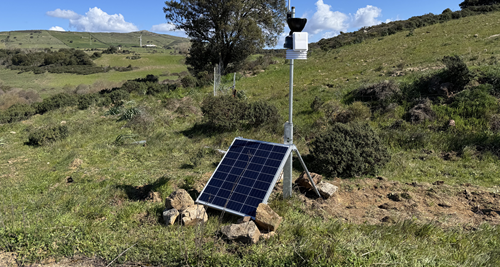
Source: INGV, 03/04/2026
Two weeks after the installation of a new magnetic and magnetotelluric station for the study of the Earth’s natural electromagnetic field and the deep geophysical characterization of the area, activities by the National Institute for Geophysics and Volcanology (INGV) continue in Sardinia, at the Onanì-Mamone Prison (Nuoro), with the deployment of a local seismic network and a weather station.
The close collaboration between the Institute, the Management of the Mamone Penal Colony, and the Sardinia Regional Directorate of the State Property Agency made these new installations possible.
The equipment used was acquired as part of the INGV’s MEET project (Monitoring Earth’s Evolution and Tectonics), funded by NRRP, which will conclude in April 2026. The project has enabled a series of measurement campaigns aimed at collecting the key data needed to support the candidacy to host the Einstein Telescope, the future third-generation European gravitational wave observatory. The Geophysical Characterization Center for the Einstein Telescope, recently established within INGV, will continue these activities by coordinating the geophysical campaigns that will be conducted in the coming months in the candidate area.
«The ongoing activities in Sardinia represent a very important step in supporting the Italian candidacy to host the Einstein Telescope, one of the most significant European scientific challenges of the coming years», comments the President of INGV, Fabio Florindo. «At the same time, this experience demonstrates how research can also generate value on a human and social level: the collaboration with the Mamone Penal Colony is a concrete example of how science, institutions, and local communities can work together, creating opportunities for growth and inclusion».
The experiment, expected to last two months, aims to identify the sources of seismic noise in the area and study how it propagates – parameters that are crucial for assessing the suitability of the site, which is characterized by extremely low levels of anthropogenic noise and is therefore particularly favorable for geophysical observations. If the recordings prove to be of high quality, the 16 installed seismic stations could be integrated into a permanent seismometric network.
The installation was carried out by four INGV researchers, supported by two colleagues from the National Institute for Nuclear Physics (INFN) and one researcher from the University of Cagliari. In the initial phases, the staff of the Penal Colony provided valuable support in identifying optimal locations for instrument placement, contributing their knowledge of the territory.
The operational phase of the installation involved six inmates from the Penal Colony, whose contribution proved decisive in completing the work on schedule. Their strength, manual skills, and ability to quickly understand technical requirements enabled the team to work efficiently, in a spirit of genuine and respectful collaboration that added a human and social dimension to the scientific value of the initiative. The inmates’ active participation in a European-scale scientific research activity represented an unusual and stimulating work experience, far removed from the facility’s daily routine. All participants hope that this small but tangible experience can contribute positively to the reintegration path of the Colony’s residents, offering them contact with the world of science and new opportunities to express their abilities and skills.